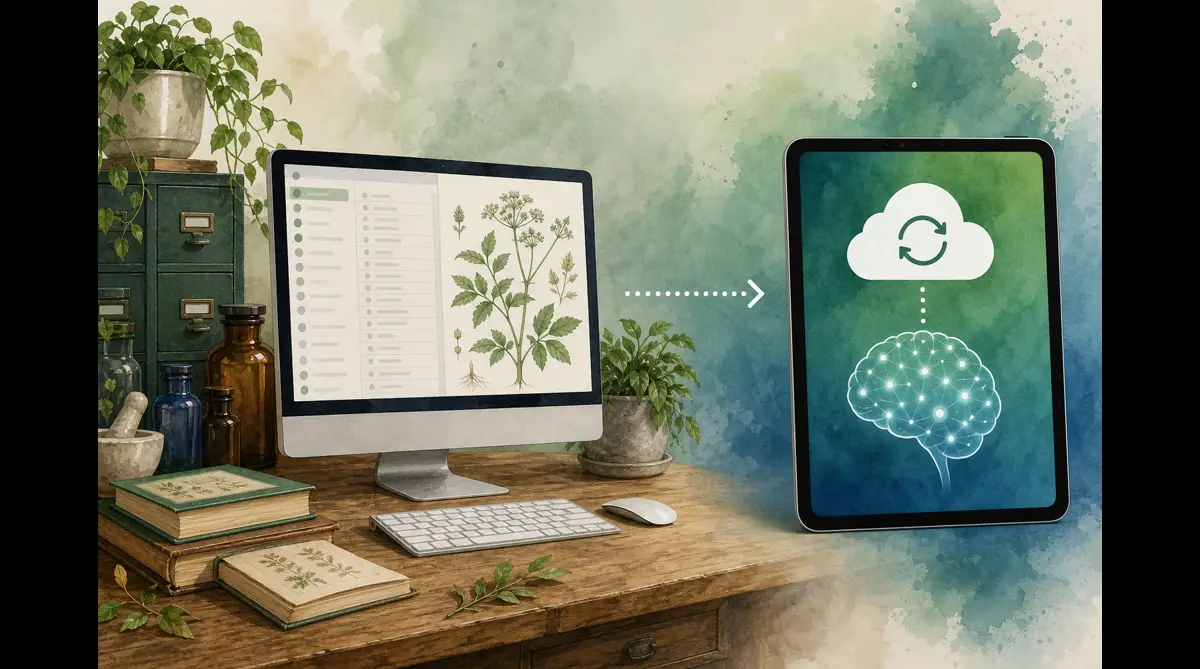

Most "clinic software" is built around the appointment book. A homeopathic practice is built around the case — and that difference is the entire specification. What a homeopath needs from software is not billing codes but a faithful record of the consultation, a fast path from that record into the repertory, a materia medica close enough to check candidates against the patient rather than from memory, a clean prescription history, and follow-ups that can be judged against the original totality instead of a vague recollection of it. This article walks through that workflow stage by stage — intake, case taking, repertorisation, verification, prescription, follow-up — and shows what purpose-built homeopathy clinic software should do at each step. As always on this blog, it is written for practitioners and students; the clinical judgement in every step remains yours. (And to say it plainly up front: Similia deliberately does not do scheduling or invoicing — the case for that focus is part of the argument below.)
The Loop That Defines Homeopathic Practice
Strip any homeopathic consultation to its skeleton and the same loop appears:
- Take the case — the patient's narrative, in their words, plus your observations.
- Analyse — translate the striking features into rubrics and repertorise.
- Verify — read the leading candidates in the materia medica against the living patient.
- Prescribe and record — the remedy decision and its reasoning.
- Follow up — reassess against the original picture; continue, wait, or re-analyse.
Every stage produces information the next stage needs, and the follow-up needs all of it. Paper handles this loop with ring binders and heroic discipline; generic practice systems handle stages 1 and 4 as free text and are structurally blind to the rest. The case for homeopathy-specific clinic software is simply that the loop should live in one place, with nothing retyped and nothing lost between stages. That is the design brief Similia is built to, and the stages below double as a checklist you can hold any software against — ours included.
Stage 1 — Intake and the Case Record
The unit of work is the patient case: identity and contact details, the presenting picture, history, and every consultation that follows, in one chronological record. Two properties matter more than any feature list.
The record must be narrative-first. Homeopathic case taking depends on the patient's own language — the "as if" phrases, the odd modality, the emphasis — because those are precisely what becomes rubric selection later. Software should therefore make long, verbatim notes effortless rather than forcing the story into structured fields. In Similia a case holds free consultation notes alongside structured elements (prescriptions, repertorisations, documents and images), so the narrative stays primary and the structure attaches to it; our case-taking guide covers the craft itself.
The record must be one record. Home visit on the phone, desk work on the laptop, reading on the tablet — the case must be identical everywhere, without exports or syncing rituals. Cloud software earns its place here: sign in anywhere and the practice is present, current and whole.
Stage 2 — Case Taking, With Your Eyes on the Patient
The classical dilemma of modern case taking is attention: the more faithfully you type, the less you observe. Two capabilities dissolve most of it.
Live transcription. Similia's live audio mode records the consultation (with the patient's informed consent — always) and transcribes it in real time into the case. You keep eye contact; the verbatim narrative still lands in the notes. For the fast half-sentences that carry keynotes — "it's as if a hand were squeezing it," "better the moment a storm breaks" — a transcript is simply more faithful than any summary typed after the fact.
Suggestions that stay on a leash. As the consultation is captured, the AI can propose rubrics matching what was said, each traceable to its repertory location and grade. The verb matters: propose. You confirm, refine or discard; nothing enters the analysis without the practitioner. That division of labour — software retrieves, homeopath decides — is the standard we argue for across all our AI writing, and it is exactly where clinic software earns trust or loses it.
Stage 3 — From Narrative to Repertorisation, Without Retyping
Here is where an integrated system stops being a convenience and starts changing the quality of the work. The striking symptoms identified in the notes need to become rubrics — and the friction of that step, in software terms, decides whether you consider three candidate rubrics or eight.
In a connected workflow: search in everyday language and let semantic search map the phrasing to classical rubric wording across 14 repertories (Kent, Murphy, the Complete Repertory, Boenninghausen and more), compare how each repertory phrases and grades the symptom, add the chosen rubrics to the case's repertorisation, and weight them. The grid ranks candidates; the analysis is saved to the case, so six months later the follow-up consultation can reopen it and see exactly which rubrics drove the prescription.
Two disciplines keep this stage honest — both old, both easier to keep with software than against it. First, fewer well-chosen rubrics beat long lists; the beginner's guide to repertorisation explains why. Second, the repertorisation proposes — the decision waits for the materia medica.
Stage 4 — Verification in the Materia Medica
No experienced homeopath prescribes from a grid. The shortlist goes back to the sources: read the remedy pictures — Boericke, Clarke, Allen, Hering, Kent — against the patient in front of you, and let the gestalt decide among arithmetically similar candidates.
Clinic software's job is to make that reading frictionless at the exact moment it competes with consultation time: every remedy in the grid one click from its materia medica entries, in the same window as the case, with search across sources. When verification costs thirty seconds instead of a shelf trip, it actually happens — on busy days too, which is when it matters most.
Stage 5 — Prescription and the Practice Memory
The prescription record closes the consultation: remedy, potency, date, and the reasoning while it is fresh — one line about what decided the case is gold at follow-up. In Similia prescriptions live as structured entries in the case history, so the practice accumulates a queryable memory of what was given and when, rather than a drawer of index cards. (What the record deliberately does not do is instruct: dosing and repetition are clinical decisions belonging to your training and judgement, not to software defaults.)
Stage 6 — Follow-Up Against the Original Totality
Follow-up is where integrated records repay everything. The question at four or six weeks is never just "better or worse?" but "what happened to the symptoms that drove the prescription?" — and answering it honestly requires the original picture, unblurred by memory.
With the loop in one place, the follow-up consultation has the first-visit narrative, the exact rubrics and their weights, the repertorisation ranking, the prescription and its rationale — all open beside today's notes. Assessment becomes comparison rather than reconstruction: which of the driving symptoms moved, what is new, whether the case needs waiting, a repeat analysis on a changed totality, or a fresh look in the sources. Each follow-up appends to the same case, and the record grows into the longitudinal story chronic prescribing actually needs.
What This Software Deliberately Doesn't Do
Honest scope is part of the specification. Similia does not do appointment booking, invoicing or accounting. Those are commodity problems, already solved well by general tools most practices run anyway — and every hour a homeopathy vendor spends rebuilding a calendar is an hour not spent on repertory quality, materia medica coverage or analysis. The practical clinic stack we see most often is pleasantly boring: a booking/calendar tool of your choice, ordinary accounting software, and Similia for everything that happens once the patient is in the room. Software that focuses on the case does the clinic's clinical work; the admin layer stays modular around it. (Our overview of digital tools in practice situates the whole stack.)
Data Protection Is a Clinical Feature
Patient cases are among the most sensitive records any practice holds, and in a homeopathic case — where the narrative is the data — confidentiality and completeness are the same problem. Whatever software you choose, the questions are: encryption in transit and at rest; strict per-account isolation of cases; a GDPR-compatible legal basis and data-processing terms; your ability to export and delete; and consent handling for recordings. Similia is built to operate under GDPR with encrypted patient data, and our HIPAA & GDPR guide for homeopathic practice walks through the practitioner's side of those obligations — consent wording, retention, patient rights — which no vendor can discharge for you.
There is also a resilience argument that deserves plain words: practices lose laptops. A local patient database on a single machine is one theft, spill or disk failure away from being gone; cloud records survive the hardware and meet you on the next device. That is not marketing — it is the boring actuarial reason cloud clinical software became the norm everywhere else in medicine.
The Checklist
Hold any homeopathy clinic software — ours included — against the loop:
| Stage | The software must… |
|---|---|
| Intake | Keep one narrative-first case record, identical on every device |
| Case taking | Capture verbatim (typing or consented transcription) without stealing attention |
| Analysis | Move from the patient's words to rubrics without retyping; multiple repertories, visible grades |
| Verification | Put the materia medica one click from the grid, in the same window as the case |
| Prescription | Record remedy, potency and reasoning as structured history |
| Follow-up | Reopen the original analysis beside today's notes |
| Scope | Do the clinical loop deeply rather than admin shallowly |
| Data | Encrypt, isolate, comply, export — and survive a stolen laptop |
Similia's free plan covers the working core of this loop — cases, notes, repertorisation across the included repertories, the classical materia medica library and semantic search — so the honest way to evaluate the argument above is simply to run one real (anonymised) case through it, intake to follow-up, and see whether the loop holds.