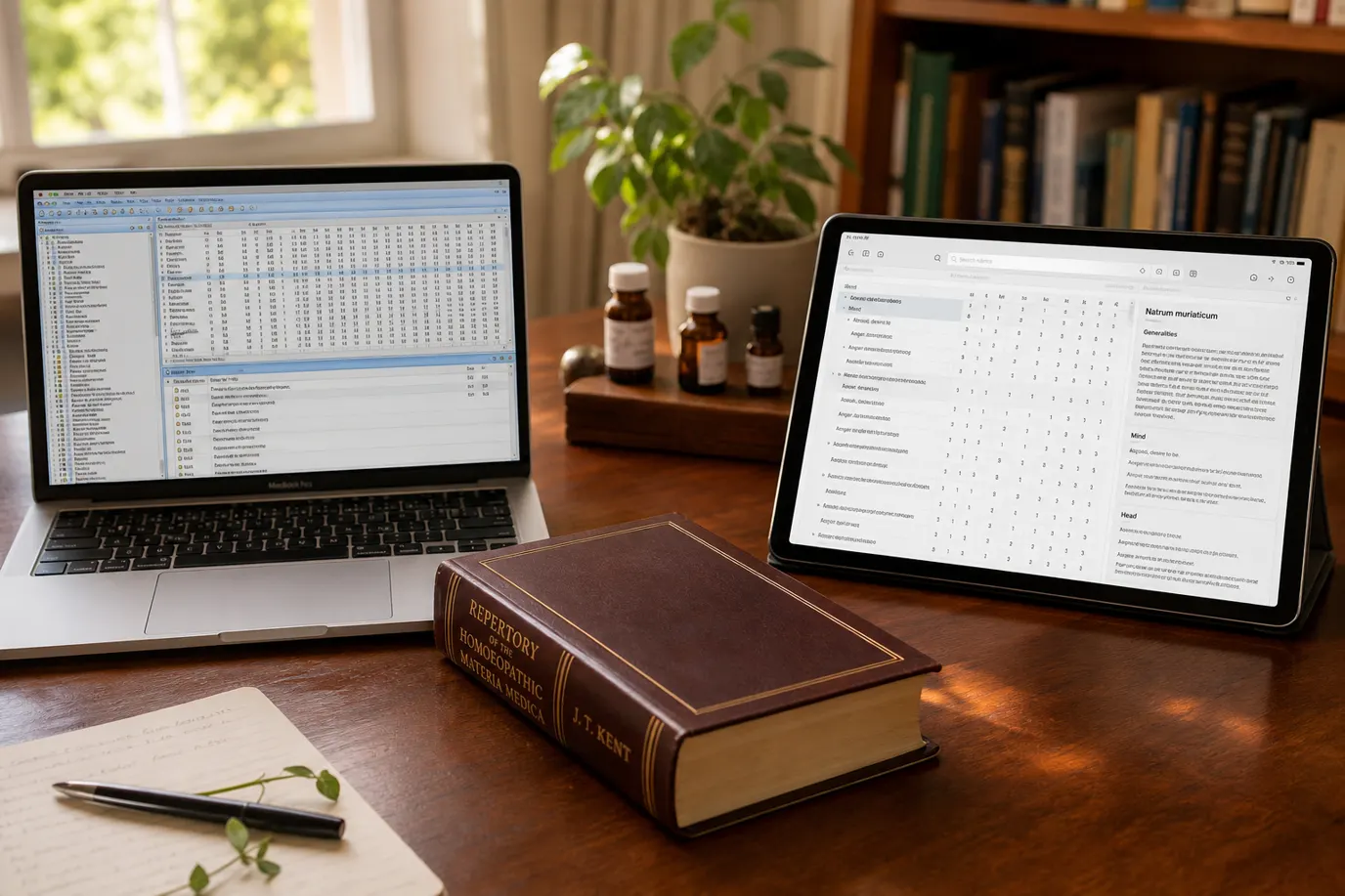

In short: "Materia Medica Lite" is the former name of an Indian Android app that its developer now publishes on Google Play as Homeopathic Materia Medica AI, while a second product, Hompath's Materia Medica Live Lite, shares the name on the App Store and is a video-learning app rather than a text library. Similia is the browser alternative for practitioners who have outgrown a phone reader: its 21 classic materia medica books are free to read as public pages, no account required. The free plan adds seven classical repertories with AI semantic search and basic case management capped at 3 new cases and 3 analyses a month. In-app materia medica search across those books requires eligible paid access, and Similia is online-first, so a fully offline library remains the installed app's advantage.
Disclosure: I'm the founder of Similia. I've tried to be even-handed below — corrections welcome by email.
Which "Materia Medica Lite" do you mean?
Two apps answer to the name, and the search results mix them up.
Materia Medica Lite, now Homeopathic Materia Medica AI. The Android app by Manohar N V (package com.manutech.mm) first appeared on Google Play on 4 March 2011 and was renamed after a rebuild. The Play listing, fetched on 20 September 2026, files it under Medical, shows a 4.4-star average from 5.81K reviews, a "500K+" install bracket, the labels "Contains ads" and "In-app purchases", and "Updated on Sep 16, 2026". The developer's own description says the app has been published in India since 2011 under the former name and puts lifetime installs at over 780,000; the two figures are different measures, so each is quoted as its source states it. Third-party mirrors have not caught up with the rename. Uptodown still lists "Materia Medica Lite 4.0.27", dated 17 September 2026, as a 47.14 MB XAPK for Android 7.0 or higher (fetched 20 September 2026), which is why "materia medica lite old version download" keeps appearing as a related search. An iOS build called Materia Medica AI, by Manohar Nagaiah in the Education category at 90.5 MB, reached version 1.0.25 on 13 September 2026 (US App Store, 20 September 2026).
The rename came with a rebuild, and not every long-time user welcomed it. Play reviews posted between June and September 2026 say the old Lite was simpler and quicker for symptom lookup; the developer's public replies describe a sole developer and say a lighter, simpler mode is being explored. If you searched for the old version, that is the story behind the search.
Materia Medica Live Lite is a different product from Hompath (Mind Technologies Private Limited). The US App Store listing, fetched on 20 September 2026, shows a free Medical app of 24.8 MB, last updated to version 1.3 in June 2019, with one rating, containing core-essence charts of 21 remedies and one full remedy video (Cannabis sativa); the full MMLive Pro app has videos of 22 remedy personality profiles. It is a video-learning product, not a text materia medica, and it is not what the rest of this page is about.
What Materia Medica AI contains
Taken from the Google Play listing text of 20 September 2026, as an inventory rather than a review. The listing describes the AI features as powered by Google Gemini.
- Materia medica: nine works stored offline: Clarke, Boericke, Kent, Allen, Nash, Phatak, Cowperthwaite's Red-Line Symptoms, a Biochemic/Tissue-Salts materia medica and a curated "Modern Homeopathic Medicine" volume, with search by remedy, symptom or keyword and bookmarks. The iOS listing names the editions as Boericke's Pocket Manual, Kent's Lectures on Materia Medica and Allen's Keynotes.
- Repertory: four repertories (Boericke, Boenninghausen, Kent and a "Collective" repertory) with classical keyword search across the rubric tree and an AI rubric search that returns rubrics present in the loaded repertory.
- AI Remedy Finder: a conversational case walk-through that extracts rubrics as you go and surfaces candidate remedies.
- AI Case-Taking Tutor: simulation against an AI patient persona, a live coach during a real consultation, and guided observation over 123 annotated historical cases, 111 of them from Kent's Clinical Cases.
- Classical texts: Hahnemann's Organon in the 5th and 6th editions (585 aphorisms across the two, as the listing counts them), Kent's Lectures on Homoeopathic Philosophy (37 lectures) and Roberts' Principles and Art of Cure (35 chapters).
- Case management: patient cases with visits, PDF export and optional private sync to the user's own Google Drive; the listing says case data never sits on the developer's servers.
- Languages: 14 interface languages: English, ten Indian languages (Hindi, Telugu, Tamil, Kannada, Malayalam, Bengali, Marathi, Gujarati, Punjabi, Odia) plus German, French and Turkish. The iOS listing counts 12.
- Commercial model: free with ads; paid plans are subscriptions through Google Play, with a seven-day trial on each. On the US App Store the in-app purchases are Ads Free $9.99, Practitioner Plan $39.99 and Clinic Plan $99.99; Play's own listing data shows in-app items from $0.99 to $99.99.
The listing states that the app is intended "for educational and professional reference" and is not a substitute for licensed care. This site writes for the same readers, practitioners and students, and nothing below is prescribing advice.
Where it fits, and where a practitioner outgrows it
Offline on the phone. The whole library lives on the device. For a BHMS student on a train or a practitioner in a clinic with unreliable connectivity that is a real advantage, and Similia's free plan does not match it: on Free, repertory searches, materia medica lookups, AI analysis and saving to a case pause behind an offline notice until you reconnect. Similia Pro's offline mode (beta) keeps the books, the repertories and recent cases on the device in the installed app, but it is a paid feature and not part of the free trial.
Phone-first, single developer. The listing says the app is built by a solo developer, and there is no browser workspace; the iOS build is listed as installable on Apple-silicon Macs but marked "Not verified for macOS". Cases are stored on the device and optionally synced to the user's own Google Drive; the iOS listing describes settings and cases following the user across devices. A practitioner who repertorises on a laptop between consultations has no equivalent surface, and a colleague or locum cannot open the practice's records from another machine.
Patient records on a personal Drive. For study cases this is fine. For a practice that must show who controls and who processes patient data, and under which agreement, the listing publishes a privacy statement and a Drive sync but not the contractual side. That is not a claim of non-compliance; it is a gap the practitioner has to close alone. Our HIPAA and GDPR guide for homeopaths lists what to ask of any software that holds patient records.
Ads and subscriptions. The free tier carries ads. The iOS listing describes the AI features as the optional Pro upgrade, and the App Store's paid plans are the Practitioner Plan at $39.99 and the Clinic Plan at $99.99; neither listing itemises what each plan contains. On the iOS listing's own description, a student who only wants the books never needs to pay; a practitioner who wants the AI will.
Breadth. Nine works against Similia's 21 classic books free to read. Be fair the other way: Phatak, Cowperthwaite's Red-Line Symptoms and the tissue-salts volume are not in Similia's free library, and Similia has neither Phatak's Materia Medica nor his Concise Repertory on any plan; Phatak appears only as one source in the Pro remedy-relationships view. If Phatak is your daily desk book, the app keeps that job.
Similia as the alternative: what is free
Two things are free on Similia, and they are separate.
Reading is free and public. The 21 classic English-language materia medica books are published as public pages, one page per remedy per author, readable without an account. Open Pulsatilla in Boericke's Pocket Manual (688 remedy pages on the hub, 1901 with the 9th edition of 1927) and you get his full entry: Boericke calls it the weather-cock among remedies, puts the disposition and mental state first as the chief guiding symptoms, lists the thick, bland, yellowish-green discharges and the thirstless, chilly patient who still wants open air, then runs the schema from Mind through the Modalities to the Relationship section. Open Sulphur in Clarke's Dictionary (1,010 remedy pages, 1900 to 1902) and you get the pharmacy first, a long Clinical index, then the Characteristics essay with Relations and Causation, and only then the numbered schema; that is the breadth the hub means when it says Clarke covers over a thousand remedies. Kent's Lectures on Homoeopathic Materia Medica (180 remedies, 1905) give the constitutional portraits of the polychrests in his own order, from the mental state through the generals to the particulars. Every page carries the same notice: historical reference for practitioners and students, not medical advice.
Searching is a plan feature. The free plan includes seven classical repertories (Kent, Boericke, Boger's Boenninghausen repertory, Knerr's repertory of Hering's Guiding Symptoms, Boger's Synoptic Key, and the Sensations As If repertories by Ward and Roberts) with AI semantic search, and basic case management capped at 3 new cases and 3 analyses per month. Cross-source materia medica search, typing a symptom and reading matching passages across authors at once, requires eligible paid access. If that symptom search is the Lite feature you use most, read the free online materia medica guide for what public reading does and does not cover, and price Pro before you switch.
Here are the 21 books, with the edition the hub records for each and whether the same author is among Materia Medica AI's nine.
| Author | Book | Edition on the hub | Also in Materia Medica AI? |
|---|---|---|---|
| H. C. Allen | Keynotes and Characteristics with Comparisons | 1899 | Yes (Allen's Keynotes) |
| T. F. Allen | The Encyclopedia of Pure Materia Medica | 1874–1879 | No |
| William Boericke | Pocket Manual of Homoeopathic Materia Medica | 1901; 9th ed. 1927 | Yes |
| John Henry Clarke | A Dictionary of Practical Materia Medica | 1900–1902 | Yes |
| Constantine Hering | The Guiding Symptoms of our Materia Medica | 1879–1891 | No |
| James Tyler Kent | Lectures on Homoeopathic Materia Medica | 1905 | Yes |
| C. M. Boger | A Synoptic Key of the Materia Medica | 1915 | No |
| C. M. Boger | General Analysis | 1931 | No |
| Adolph von Lippe | Keynotes of the Homoeopathic Materia Medica | 1886 | No |
| Adolph von Lippe | Keynotes and Red Line Symptoms | posthumous compilation | No |
| Adolph von Lippe | Text Book of Materia Medica | 1866 | No |
| E. B. Nash | Leaders in Homoeopathic Therapeutics | 1899; 4th ed. 1913 | Yes (author named, title not) |
| John Paterson | The Bowel Nosodes | 1950 | No |
| Samuel Hahnemann | Materia Medica Pura | 1811–1821 | No |
| Samuel Hahnemann | The Chronic Diseases | 1828–1830 | No |
| E. A. Farrington | A Clinical Materia Medica | 1887 | No |
| Carroll Dunham | Lectures on Materia Medica | 1878 | No |
| Henry N. Guernsey | Key-Notes to the Materia Medica | 1887 | No |
| Richard Hughes and Jabez P. Dake | A Cyclopaedia of Drug Pathogenesy | 1886–1891 | No |
| Edwin M. Hale | Materia Medica and Special Therapeutics of the New Remedies | 1864; 5th ed. 1880–1882 | No |
| H. C. Allen | The Materia Medica of the Nosodes | 1910 | No |
Five authors overlap. Sixteen books, among them Hering's ten volumes, T. F. Allen's provings, Hahnemann's two works and the three Lippe titles, are on Similia and not in the app.
Installing Similia like an app on Android, iPhone and desktop
Similia is a progressive web app, so the phone-first reader does not have to give up the icon on the home screen. In Chrome on Android, open similia.io, sign in, and choose Install app (on some devices, Add to Home screen) from the browser menu; in Safari on iPhone or iPad, use the Share sheet and Add to Home Screen; in Chrome or Edge on a PC or Mac, click the install icon at the end of the address bar. Each takes under a minute and is walked through step by step in the install guide for Android, iPhone and desktop. There is no APK, nothing passes through a store, and updates arrive on reload.
Offline, the honest sentence once more: on the free plan, pages you have already opened re-open from the cache and stay readable, but searches, lookups, AI analysis and saving to a case need a connection. With Pro, the installed app's offline mode (beta) keeps books, repertories and recent cases on the device; the AI tools still need a connection.
Side-by-side
Store facts come from the Google Play and US App Store listings fetched on 20 September 2026; Similia's plan wording is its published pricing copy.
| Dimension | Materia Medica AI (formerly Materia Medica Lite) | Similia |
|---|---|---|
| Platform | Android app; iOS app. | Browser, and installable web app on any device. |
| Offline | Full library on the device. | Free: online-first, opened pages re-open from cache. Pro: offline mode (beta) in the installed app keeps books, repertories and recent cases on the device; AI needs a connection. |
| Materia medica | 9 works offline, searchable by symptom. | 21 classic books public to read; cross-source materia medica search requires eligible paid access. |
| Repertories | 4 (Boericke, Boenninghausen, Kent, Collective). | 7 classical on the free plan; a premium repertory on the Murphy, Complete and Saine Pro editions. |
| AI | Gemini-powered rubric search, remedy finder and case-taking tutor, sold as the paid Pro upgrade. | AI semantic repertory search on the free plan. Notes-to-Rubric, case analysis, live audio transcription and photo analysis on Pro, using credits. |
| Cases | On the device, optional sync to the user's Google Drive, PDF export. | Cloud-synced across devices. Free plan: 3 new cases and 3 analyses a month. Pro: unlimited cases and analyses. |
| Price | Free with ads. Play: subscriptions with a 7-day trial, in-app items from $0.99 to $99.99. App Store: $9.99, $39.99, $99.99. | Free forever. Pro from $19.99/mo; 14-day trial for eligible first-time subscribers, checked at checkout. |
| Languages | 14 interface languages (Play); 12 (App Store). | 18 interface languages. |
| Records governance | Privacy statement; data on the device or the user's Drive. | Encryption in transit and at rest, authenticated access, export and deletion tools; consent and provider terms per feature in the HIPAA and GDPR guide. |
What Pro adds, and what it costs
Pro is where the app's AI tier and Similia's meet. Every Pro edition adds the AI toolkit (Notes-to-Rubric, AI case analysis, live audio transcription and photo analysis), unlimited cases and analyses, cross-source materia medica search and Jan Scholten's series; Pro Murphy, Pro Complete and Pro Saine each add their edition's premium repertory, while Pro Base adds none and keeps the classical seven. AI-toolkit operations use credits, so unlimited cases do not mean unlimited AI processing. The published prices on the pricing page are Pro Base $19.99/mo, Pro Murphy and Pro Complete $29.99/mo and Pro Saine $26.99/mo; eligible first-time subscribers get a 14-day trial, with eligibility confirmed at checkout. Against the app's Practitioner Plan at $39.99 on iOS, the difference is not the price but the surface: a phone tutor on one side, a desk workspace with patient records on the other.
Which to choose
Student with a phone and patchy connectivity. Keep the app. It has the nine books offline, and its Organon, Kent's Philosophy and Roberts make a real study set. Use Similia's public pages for the sixteen books the app lacks, Hering and T. F. Allen above all, whenever you are connected; no account is needed for that.
Practitioner at a desk with patient records. Similia. Repertorise on the laptop, read the entry on the same screen, save to the case, open it on the phone at the follow-up. Start on the free plan. Add Pro when the AI toolkit or the monthly cap on cases becomes the limit.
Both. Many students end up here: the offline app for the train, Similia at the desk. The two do not share cases, so decide early which one holds the records and keep it that way.
For the wider field, the best homeopathy apps of 2026 roundup sorts phone apps by the job they do; this page is its materia-medica-reader deep dive.
Read the books now
Nothing here requires a sign-up. Boericke, Clarke, Kent, both Allens, Hering, Nash and the rest are public pages under the materia medica library; open a remedy and read it as you would in the app, on any screen. If you then want the seven classical repertories searched in plain language, create the free account. Symptom search across the materia medica, patient records without a monthly cap and the AI toolkit are Pro, and the pricing page has the numbers.