
Reason by Family in an Analysis
Flag rubrics that hold a majority of a taxonomy family and read the analysis grid by family, as a working hypothesis beside the remedy ranking.
Family reasoning adds two informational layers to the analysis grid: a hint on each rubric that holds a majority of a family's documented members, and a "By family" view that groups the remedy columns into taxonomy families. Neither changes the remedy ranking. A third, opt-in layer, the family-adjusted ranking, does re-sort the remedies and is clearly labelled as a working hypothesis while it is on.
Before you start
Family reasoning requires Pro. Open a case analysis with a few rubrics on the sheet. The families follow the classification system selected in the Taxonomy filter: Standard by default, or Scholten's family level when that tab is active.
Turn on family hints
- Open the analysis and switch to Analysis so the remedy grid is visible.
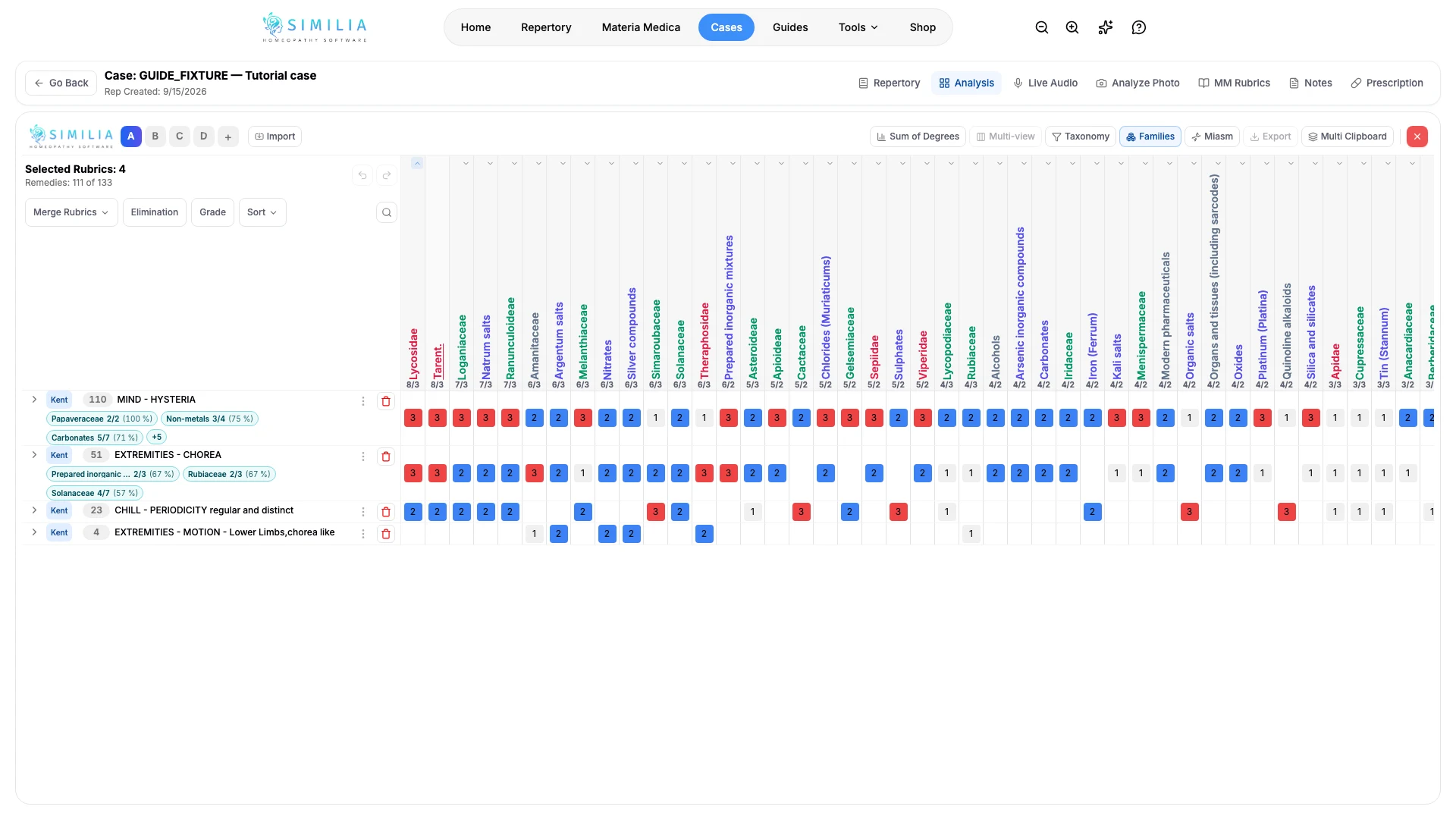
- Select Families in the toolbar: the remedy columns become one column per family. Click a family header to show its member columns inline; click again to collapse them.
- Open the arrow next to Families and turn on Family hints on rubrics.
- Click a teal hint such as "Arachnids - Spiders 3/4 (75 %)" to see which documented members are present and which are absent.
- In the same panel, switch the taxonomy between Standard and Scholten to regroup the families, and choose the family level: Broad group reasons about spiders, snakes or birds as one family, Taxonomic family keeps Lycosidae apart from Theridiidae. Under Advanced, adjust the majority threshold (50, 60 or 70 %), the minimum members present and the documentation floor only if the defaults do not fit the case.
- Sort by degrees or number of rubrics to rank the families.
Try the family-adjusted ranking
- In the same panel, turn on Family-adjusted ranking and pick the weight of the bonus (λ = 0.25, 0.5 or 1). The Sort menu switches to Family-adjusted, the Families button lights up, and each remedy header shows its adjusted total over a "family +N" line; click that line to see which rubrics contributed and how much.
- Turn the option off, or choose any other ranking in the Sort menu, to return to your usual ranking exactly as it was.
What you should see
Rubrics that hold a majority of a family's documented members carry a teal hint with the present-over-documented count and its percentage. In the family view each column is a family, its grade in a rubric is the highest grade among its members, and its header shows how many members are on the sheet and how many are documented in the repertory.
If something looks wrong
- If the Families button is locked, confirm Pro access.
- If hints do not appear, open Advanced and lower the threshold or the documentation floor; small families with fewer documented members than the floor are never flagged.
- If the hints read "unavailable", an author filter is active. Family reasoning needs the complete remedy list of each rubric.
- If a remedy is missing from the family view, it has no family in the selected taxonomy; the Families panel reports how many were left out.
- Export and Multi-view are unavailable while the family view is on; switch back to remedy columns first.
- The family-adjusted ranking is hidden in Multi-view, not applied while the family view is on (family columns are aggregates), and unavailable while an author filter is active; it needs the complete remedy list of each rubric.