


Philip Bailey's Homeopathic Psychology describes the personality of 36 constitutional remedies, each from the author's own practice. Published in 1995, it is a widely read modern book on the mental picture of the polychrests. This guide covers who Bailey is, how a profile is built, the 36 remedies in the book, how to use it without over-relying on it, and where to read it.
Read Lycopodium free. Bailey's Lycopodium profile is open in full in Similia after signing in. The complete book is a one-time add-on. See Homeopathic Psychology →
The book and its author
Homeopathic Psychology: Personality Profiles of the Major Constitutional Remedies was first published in 1995 by North Atlantic Books and Homeopathic Educational Services.
Philip M. Bailey (M.B., B.S., MFHom.) trained as a medical doctor at Westminster Hospital Medical School in London. He studied homeopathy at the Royal London Homeopathic Hospital and with George Vithoulkas, and gestalt therapy at the Esalen Institute. When the book appeared he was working as a doctor and homeopath in Perth, Australia. He later wrote Lac Remedies in Practice and Carcinosinum: A Clinical Materia Medica.
That mix of medicine, classical homeopathy and psychotherapy explains the book's angle: it is about personality, and about little else.
How a profile is built
Most profiles follow the same plan.
- A keynote. One line that names the centre of the type. Bailey's keynote for Lycopodium is impotence; for Aurum it is loathing of life.
- Themes. The personality is then followed theme by theme, each under its own heading. The Lycopodium profile, for example, has sections on the people pleaser and on the intellectual.
- Men and women. Where he can, Bailey gives the rough proportion of men to women he has seen in a type and describes how it shows differently in each, as in the Lycopodium woman, the Sepia man and the Pulsatilla man.
- Physical appearance. Each profile closes with how the type tends to look.
Two points set the book apart from the classical materia medicas. The profiles come entirely from Bailey's clinical experience, not from earlier books. And he says plainly when his picture differs from the traditional one, which at times it does considerably.
The 36 remedies
In Bailey's experience these are the types most often seen among patients with chronic complaints.
| Alumina | Anacardium orientale | Argentum nitricum | Arsenicum album |
| Aurum metallicum | Baryta carbonica | Baryta muriatica | Belladonna |
| Calcarea carbonica | Causticum | China officinalis | Graphites |
| Hyoscyamus niger | Ignatia amara | Kali carbonicum | Lachesis |
| Lycopodium clavatum | Medorrhinum | Mercurius solubilis | Natrum carbonicum |
| Natrum muriaticum | Natrum sulphuricum | Nux vomica | Phosphoricum acidum |
| Phosphorus | Platina | Pulsatilla | Sepia |
| Silicea | Staphysagria | Stramonium | Sulphur |
| Syphilinum | Thuja occidentalis | Tuberculinum | Veratrum album |
The list is the polychrests plus the main nosodes. Small remedies are not covered.
How to use it in practice
To recognise a type. Bailey describes people, including the healthier members of a type, more than he lists symptoms. A portrait of how a Natrum muriaticum or a Sepia person behaves from day to day helps to see the remedy in a patient whose symptoms are not extreme.
To tell neighbours apart. Most profiles set the type against remedies it can be mistaken for. Read the two profiles side by side, then check the difference in the repertory. Our comparisons of Ignatia and Natrum muriaticum and of Pulsatilla and Sepia show the same exercise on Kent's rubrics.
To confirm, last. After repertorisation has given a shortlist, the profile of each candidate is a fast test of fit: does this sound like the person in the chair?
What it cannot do
- It is not a full materia medica. There are few physical generals, no modalities and no particulars. A remedy chosen on personality alone, against the physical picture, is a guess.
- It is one clinician's experience. That is the value of the book and also its limit. Compare each profile with Kent's lecture on the same remedy and with the proving-based sources.
- Types are not people. Bailey gives approximate proportions, not rules, and a patient who fits a profile only in part is common.
Our guide to constitutional prescribing sets this kind of portrait in its history, from Kent to Vithoulkas, and explains where personality belongs in the hierarchy of symptoms.
Reading and searching it in Similia
The book is licensed to Similia and sits in the Materia Medica library as its own source, Bailey Psychology. The steps are in the guide Use Homeopathic Psychology.
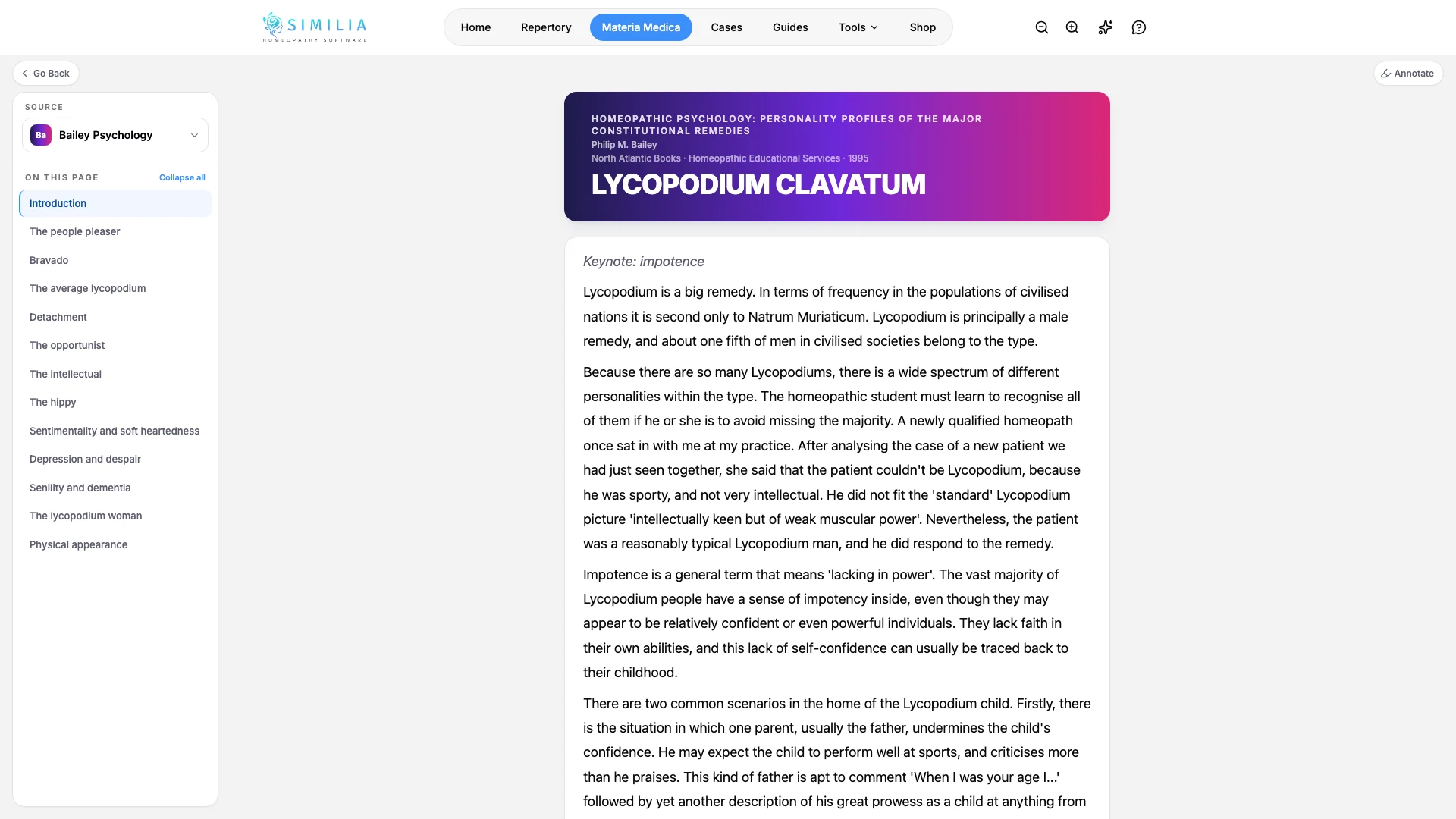
- Sample. Lycopodium clavatum is open in full after signing in, from its keynote to the type's physical appearance.
- The whole book. All 36 profiles are a one-time purchase, kept permanently. It is available with a Free or Pro account, and no plan includes it.
- Search. Owners can search the profiles by keyword, or describe a trait in plain language and let AI semantic search find the profiles that mean the same thing. Semantic search matches the meaning of a phrase such as "needs to be liked and avoids conflict", whatever words Bailey used.
- Language. The profiles are in English only.
Using the book as a source inside AI case analysis or the AI assistant needs Pro, and those tools use AI credits as usual.
Books to read with it
- For the full remedy: Kent's Lectures on Homoeopathic Materia Medica and Tyler's Homoeopathic Drug Pictures, both free in the materia medica.
- For the method: our guides to constitutional prescribing and to the polychrest remedies.
- For a wider shelf: the best homeopathy books for students and practitioners.