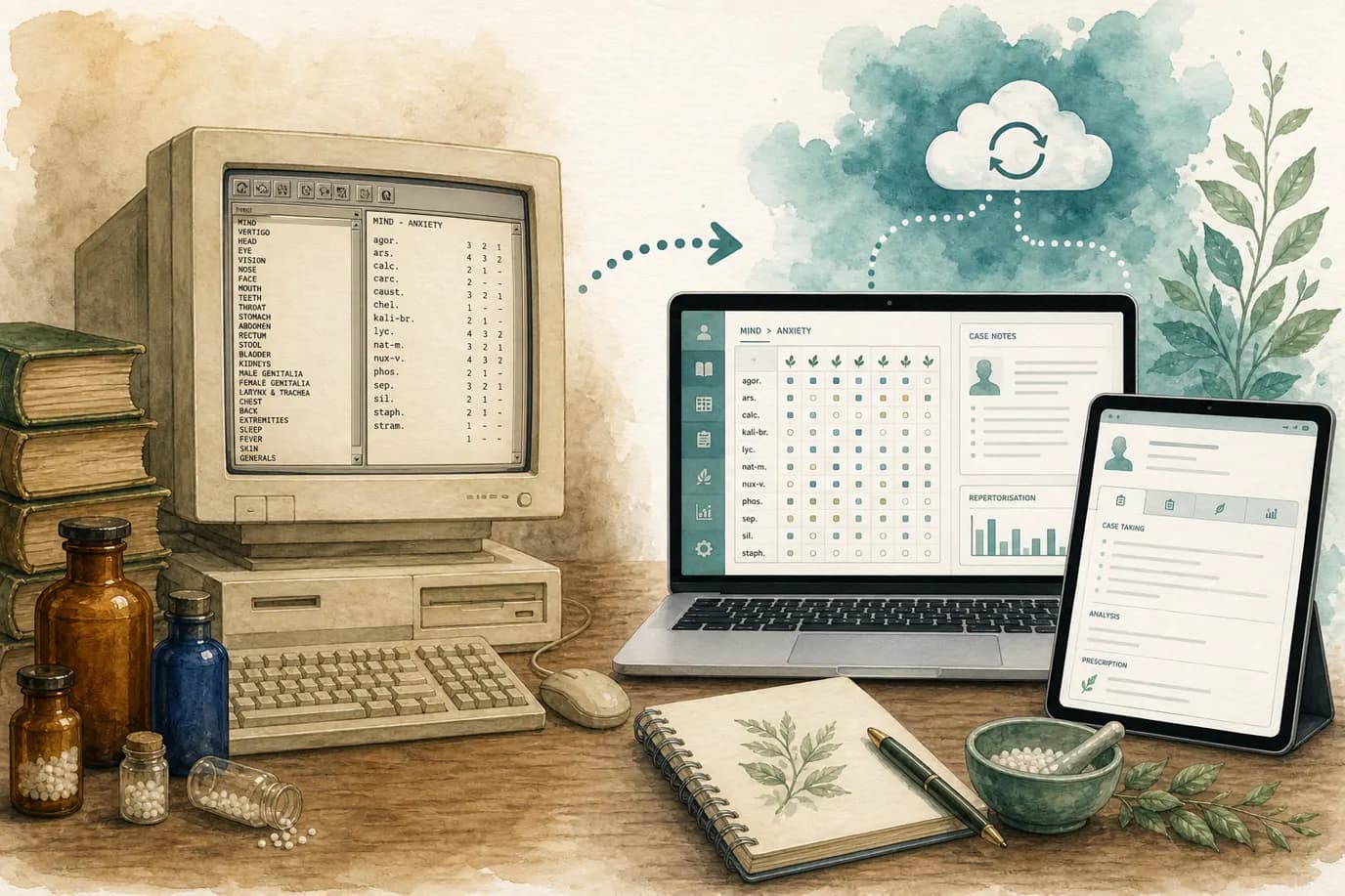

You do not need to download anything to run free homeopathic software on your phone or computer — you install it straight from the browser. Similia is a progressive web app: open similia.io on Android, iPhone, PC or Mac, sign in to the free account, and add it to your home screen or desktop in under a minute. No APK from a file-sharing site, no setup.exe, no store account, and no version 2.3 waiting on a DVD — the app icon on your device always opens the current release, with your cases and repertorisations synced across every device you sign in on. This guide walks through the install on each platform, explains honestly what works offline and what doesn't, and answers the question behind the search: why modern repertory software stopped being something you download at all. (As with everything on this blog, it is written for practitioners and students, not as self-treatment advice for the public.)
Why There Is No "Free Download" — and Why That's the Good News
Search for homeopathic software free download or free homeopathic software for Android and you will find a landscape of decade-old installers, trial versions that expire, and APK mirrors of uncertain provenance. The intent behind those searches is perfectly reasonable — a homeopath wants the repertory and materia medica on their own device, available at the chairside, without paying for the privilege. What has changed is how that is delivered.
Installed desktop programs of the classical era tied your library to one machine. The licence lived on that computer; the backups were your problem; and every new edition meant a new download, a new licence code, and often a new fee. Mobile was, at best, a separate app with a separate database that didn't talk to the desktop one.
A progressive web app inverts all of that. The software runs in the cloud and presents itself as an app on each of your devices. Concretely, that means:
- One account, every device. Start a case on the desktop between consultations, reopen it on your phone at a home visit. Nothing to export, nothing to reconcile.
- Always the current version. Updates ship server-side. The icon you tap today opens a newer, better program than the one you installed — with your data untouched.
- Nothing to trust blindly. You never sideload a package from an unofficial mirror. The "install" is your own browser pinning a secure website to your home screen.
- No storage anxiety. The 500,000+ rubrics of a full repertory library live on the server, not in your phone's storage.
The free plan is genuinely free — sign-up, Kent's repertory and the core library, semantic search and case management, with no credit card and no expiry — so the "free download" question really does collapse into a one-minute install. Here is the minute, platform by platform.
Install on Android (Chrome)
- Open similia.io in Chrome on your phone or tablet and sign in (or create the free account).
- Tap the ⋮ menu in the top-right corner of Chrome.
- Tap Install app — on some devices and Chrome versions this reads Add to Home screen.
- Confirm the name and tap Install.
Android places the Similia icon on your home screen and in your app drawer. From then on it launches in its own window — no address bar, no tabs — and behaves like any installed app: it appears in the recent-apps switcher, and you can long-press the icon for shortcuts. Because it is a web app, it requests none of the invasive permissions a Play Store APK typically wants; it cannot read your contacts, your photos or your location.
Two practical notes for Android users. First, if you use a non-Chrome browser, the wording differs slightly — Samsung Internet calls it Add page to → Home screen, Edge on Android calls it Add to phone — but every major Android browser supports the same install. Second, if you previously bookmarked the site, delete the bookmark after installing so you always enter through the app icon and get the full-screen experience.
Install on iPhone and iPad (Safari)
Apple routes web-app installs through Safari's Share sheet rather than a pop-up prompt, so the steps look different but are just as quick:
- Open similia.io in Safari (the install option is not available from inside other iOS browsers or in-app browsers such as Instagram's — if you arrived from a social link, tap through to Safari first).
- Tap the Share button — the square with the upward arrow.
- Scroll down and tap Add to Home Screen.
- Confirm the name and tap Add.
The Similia icon appears on your home screen and opens full-screen in its own window, signed in to the same account as every other device. On an iPad this is a genuinely pleasant way to work through a case: the repertorisation grid gets the whole screen, and the Apple Pencil scrolls and selects rubrics naturally.
Install on Desktop — Windows PC and Mac
On a computer the install turns Similia into a windowed desktop app with its own icon in the taskbar or Dock:
- Open similia.io in Chrome or Edge and sign in.
- Look for the install icon at the right end of the address bar — a small monitor with a downward arrow — or open the browser menu and choose Install Similia… (Chrome) / Apps → Install this site as an app (Edge).
- Confirm. The app opens in its own window, and the icon lands in your taskbar (Windows) or can be kept in the Dock (Mac).
Safari on macOS Sonoma and later supports the same idea via File → Add to Dock. Firefox does not currently offer desktop web-app installs, so Firefox users should simply keep a pinned tab — the software itself is identical.
For practitioners coming from installed desktop programs, this is the step that makes the difference in daily use: Similia gets an Alt-Tab/Cmd-Tab identity of its own next to your patient-management and email windows, instead of living somewhere among thirty browser tabs.
What You Get Once It's Installed
Installing changes the container, not the contents — and that is the point. The icon opens the same free software you had in the browser:
- The repertory library your plan includes — the free classical set of seven (Kent, Boericke, Boenninghausen, Hering, Boger and more) on the free plan, with premium repertories such as Murphy's MetaRepertory and the Complete Repertory unlocked on Pro — searched together, with grades preserved (see what repertory software actually does for how that works).
- A classical materia medica library — Boericke, Clarke, Allen, Hering, Kent and more — cross-linked from every remedy in every rubric.
- Semantic search: type the symptom in everyday language and let the software map it to classical rubric wording.
- Case management: every repertorisation saved to the patient's case, synced across your devices.
- The same account and plan. Install on three devices and you have one practice, not three copies. Nothing about installing costs anything or moves you off the free plan.
Startup is faster from the icon than from a cold browser tab, and the app window keeps its own size and position — small conveniences that add up when you open the repertory a dozen times a day. Students in particular tend to live on the phone install; if that is you, the student's guide to repertorisation software covers study workflows in more depth.
Offline, Honestly
A repertory app you might open at a home visit has to be honest about connectivity, so here is the plain version.
Similia is online-first. Your cases sync across devices, search runs on the server, and the AI features are cloud services — that is what makes the one-account-everywhere model work. The installed app caches pages you have already visited, so they will usually re-open on a flaky connection, and whatever is on screen stays readable. But be precise about the boundary: everything live needs the server — repertory searches, materia medica lookups, AI analysis and saving to a case all pause behind an offline notice until you reconnect.
In practice, for settings where you know the internet is unreliable: open what you expect to need while connected, keep the app open, and let the case notes sync when the connection returns. What you should not expect — from Similia or from any honest cloud app — is the entire 500,000-rubric library resident on your phone. If your practice genuinely requires a fully offline library on one machine, a classical installed program remains the right tool for that specific constraint; for everyone else, the trade — always-current software, synced cases, every device — is heavily in the cloud's favour. Our overview of digital tools in homeopathic practice goes further into that trade-off.
Uninstalling, Updating, and Housekeeping
Three questions practitioners ask after installing:
Updating. There is nothing to do. The app updates itself; a reload picks up the newest version. You will never see an "end of support" notice for an edition you bought, because there are no editions.
Uninstalling. Long-press the icon on Android or iOS and remove it, or on desktop open the app menu and choose Uninstall. Your account and cases are untouched — the install is only a doorway, and signing in from any browser brings everything back.
Multiple devices. There is no device limit on the free plan. Phone, tablet, consulting-room desktop and home laptop can all be signed in; cases appear everywhere within moments of saving.
The Bottom Line
If you arrived here searching for a free homeopathic software download for Android — or an iPhone app, or something to install on the clinic PC — the answer is better than a download: install the free homeopathic software as an app on every device you own, from the browser, in about a minute each. No APK, no licence key, no version lock-in, and the same synced practice wherever you open it. Create the free account once, install where you work, and spend the time you would have spent on setup reading rubrics instead.