


A reverse repertory lists every rubric that contains a given remedy, together with the grade the remedy has in each one. A repertory normally takes you from a symptom to its remedies. Reversed, it takes you from a remedy to its symptoms, in the repertory's own words. This guide explains what that is good for, where it misleads, and how to run it on Kent's Repertory online at no cost.
Try it on Kent's Repertory. The reverse repertory is part of Similia's repertory search and works on the eight classical repertories included with every account. Open Kent's Repertory →
What a reverse repertory shows
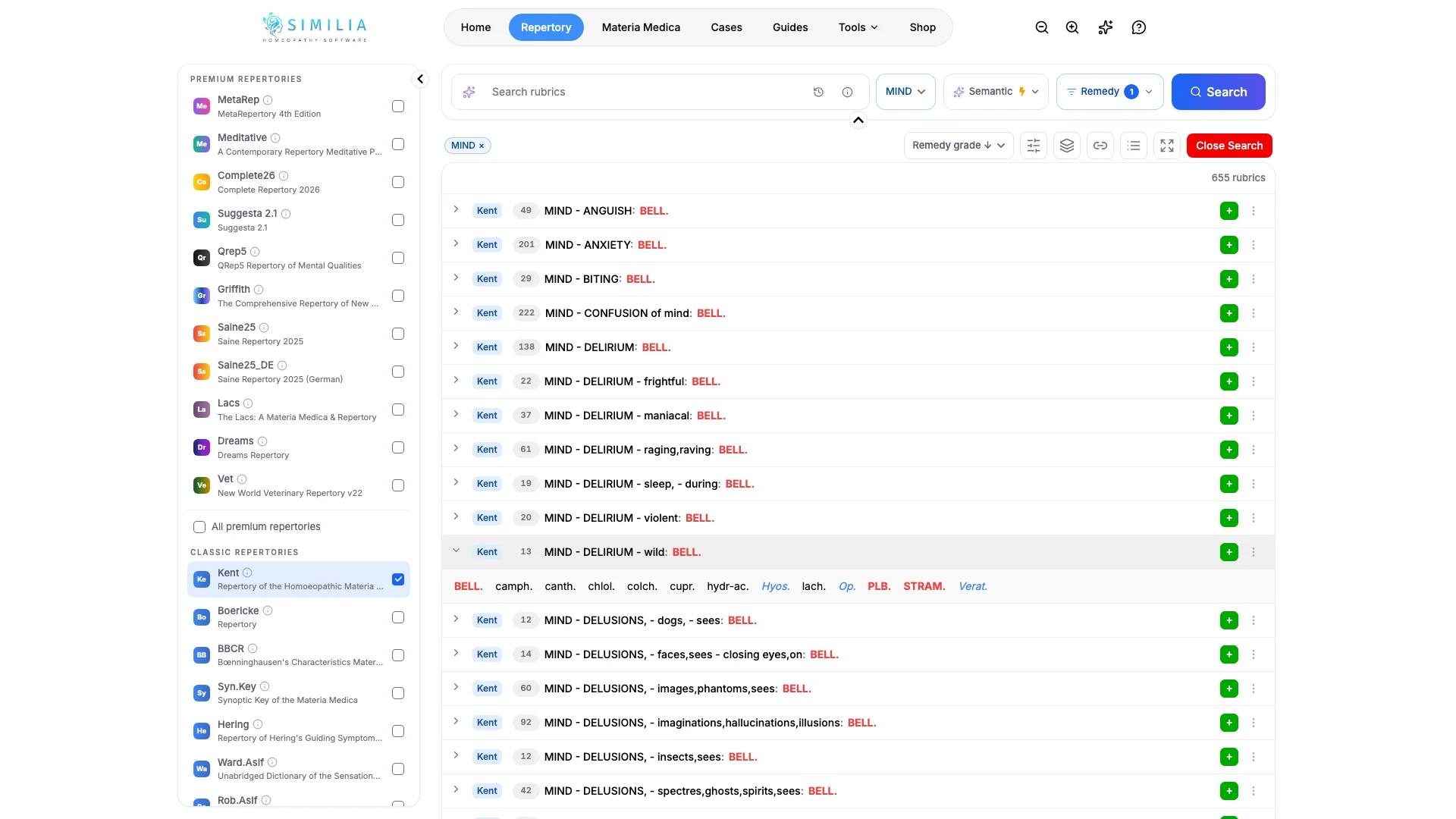
Take Belladonna in the MIND chapter of Kent's Repertory. A normal search starts from a rubric, say a fear or a delusion, and shows the remedies under it. The reverse search starts from Belladonna and returns the rubrics of MIND in which Kent entered it, each printed with Belladonna in the style of its grade, from the first degree to the third.
Three things become visible that are hard to see any other way:
- Where the remedy is strong. Ordered by grade, the list opens with the rubrics in which the remedy stands in the highest degree.
- How the remedy is spread. Filtered by chapter, the list shows whether a remedy lives mostly in MIND, in the generals, or in one region of the body.
- Which small rubrics hold it. Ordered by the number of remedies in each rubric, the list brings up the rubrics with few remedies. A remedy that is one of four in a rubric says more than a remedy that is one of two hundred.
What it is good for
Studying a remedy in repertory language
Students learn remedies from the materia medica and then struggle to find the same symptoms in the repertory, because the repertory words them differently. Reading a remedy's rubric list closes that gap. After a lecture by Kent on a remedy, the list of its third-grade rubrics in his own repertory is a compact revision sheet, in the wording you will have to recognise at the next case.
Preparing a differential
Two remedies that look alike in a case usually share many rubrics and differ in a few. Select both remedies and the reverse repertory can list the rubrics that contain both, or the rubrics that contain at least one. Narrow the list with a word such as fear, thirst or sleep, and the shared and the separate ground of the two remedies in that area is on one screen. Our remedy comparisons, such as Rhus tox vs Bryonia, are built on this kind of reading.
Checking a remedy after repertorisation
When a repertorisation puts a remedy near the top, the reverse view is a quick sanity check: is the remedy carried by a handful of large, common rubrics, or does it also stand in the characteristic ones? This does not replace reading the remedy in the materia medica, but it tells you what to look for there.
Getting to know a small remedy
A remedy with forty rubrics in the whole repertory can be read in full in a few minutes. For small and rarely used remedies, the complete rubric list is often the fastest overview a repertory can give.
How to use the reverse repertory on Kent online
These steps follow the Similia guide Use the Reverse Repertory, which has the full detail.
- Open Repertory and choose Kent's Repertory, or any other repertory you want to study.
- Select the Remedy pill beside the search box.
- Type the remedy's name or abbreviation and select it from the list.
- Leave the search box empty and select Search.
- Read the list. Each rubric prints the remedy after its name, in the style of its grade, and the result count shows how many rubrics contain the remedy.
- Use the sections menu beside the search box to keep one chapter, such as MIND.
- Select a rubric to open it and see the other remedies it contains.
Four ways to narrow the list
| Narrow by | How | What it leaves |
|---|---|---|
| Degree | Clear the degrees you do not want in the Remedy pill | Only the rubrics where the remedy has the grades you kept |
| A second remedy | Add another remedy and choose All remedies or Any remedy | The rubrics two remedies share, or the rubrics of either |
| Words | Type a word in the search box and search again | The remedy's rubrics that match the word, such as every fear rubric |
| Order | Sort by Remedy grade, Relevance or Remedies | The strongest rubrics first, or the smallest rubrics first |
The reverse repertory works the same way in every repertory an account can open. The eight classical repertories, Kent among them, are included on every plan; a premium repertory needs its own plan or add-on.
Where a reverse repertory misleads
The list is the compiler's, not the remedy's. A rubric list shows where one author entered the remedy. Kent's list for a remedy is Kent's reading of the provings and clinical records available to him, fixed when his work on the repertory ended. The same remedy has a different list in Boenninghausen's Therapeutic Pocket Book or in a modern repertory.
Polychrests look bigger than they are. Well-proved remedies stand in thousands of rubrics because they were proved and used the most. A long list is a record of how much was written about a remedy. It is no measure of how often the remedy is indicated.
A grade is emphasis. The third grade in Kent marks a symptom that provers produced repeatedly and that was confirmed in practice. It says nothing about your patient until the symptom is really there, in that form.
Rubrics drop the context. A rubric keeps the symptom and loses the sentence around it: who had it, when, with what else. The materia medica keeps that. Our guide to materia medica and repertory explains why the two books are meant to be used together.
Reverse repertory and the printed book
In a printed repertory this search is close to impossible. Finding every rubric that contains one remedy means reading the whole book, which is why the question was rarely asked before software. A database answers it in a moment, and it can combine the remedy with a chapter, a grade or a word, which no index in print could do.
That is also why the reverse repertory is a good first exercise for students who are new to Kent's structure: pick a remedy you know well from the materia medica, list its rubrics in one chapter, and compare the repertory's wording with the text you already know. If you are new to rubrics and grades altogether, start with our beginner's guide to repertorisation.
In short
- A reverse repertory goes from a remedy to every rubric that contains it, with its grade.
- It is a study and differential tool: strongest rubrics, small rubrics, shared rubrics.
- It shows one compiler's view of the remedy, so read it next to the materia medica.
- It runs on Kent's Repertory and the other classical repertories in Similia on every plan: open Kent's Repertory and select the Remedy pill.