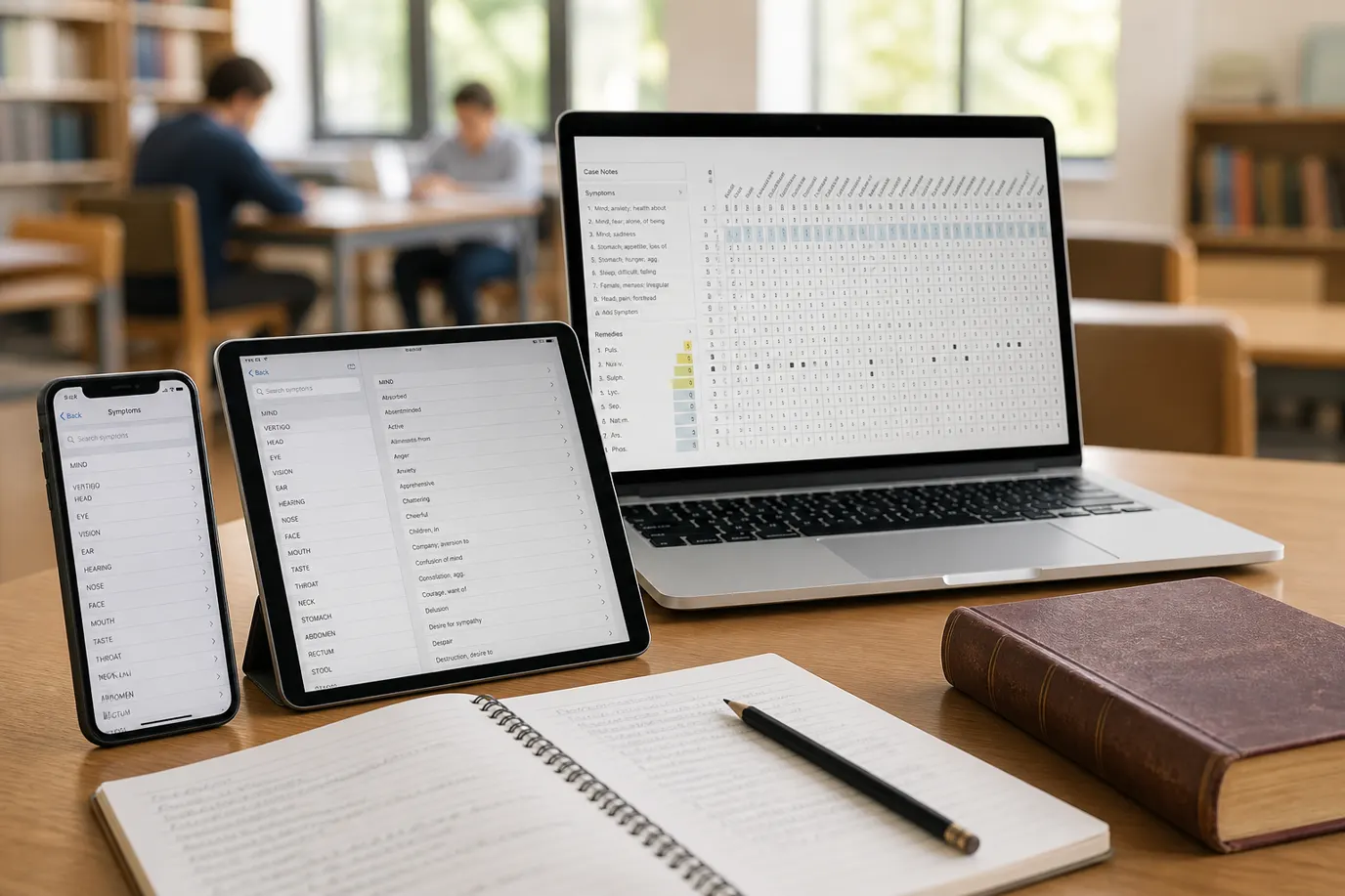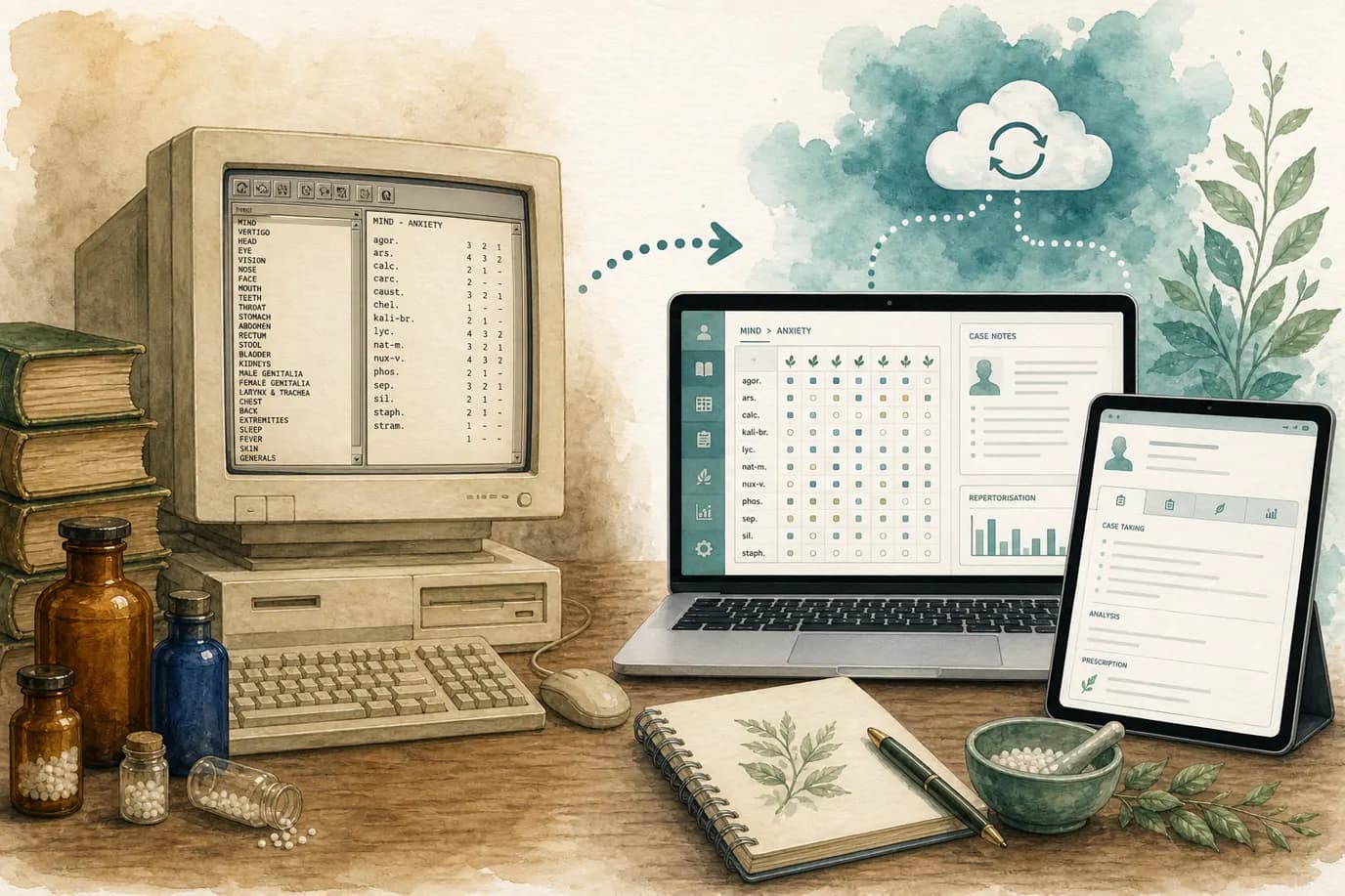


The phone has quietly become the most-used device in homeopathic practice — not for grand analysis sessions, but for everything around them: the rubric check between patients, the materia medica read on the train, the house-call case notes, the follow-up message that needs last month's prescription. "Best homeopathy app" is therefore really four questions in one, because four different kinds of app carry that name.
Here's the 2026 landscape by category, and — more useful than any ranking — the criteria that decide whether a homeopathy app earns a place on your home screen.
The four kinds of "homeopathy app"
1. Repertory apps. Digital access to the classical repertories — chapters, rubrics, grades. The floor of the category is a searchable public-domain Kent; the ceiling is licensed modern repertories with semantic search that understands "fear of being alone at night" without you knowing Kent's phrasing. If you use one homeopathy app, it's this one.
2. Materia medica readers. The remedy literature in your pocket — Boericke on the train, Kent's lectures in the waiting room. Free readers of public-domain texts are plentiful and genuinely good; the step up is integration, where the materia medica opens from inside your repertorisation instead of in a separate silo.
3. Remedy finders. Symptom in, remedy suggestions out — a category that ranges from keyword toys to serious repertory-backed engines, and worth understanding before trusting. We've dissected it in the remedy finder guide; the one-line version is: use finders that show their rubrics, and keep household finders to household scope.
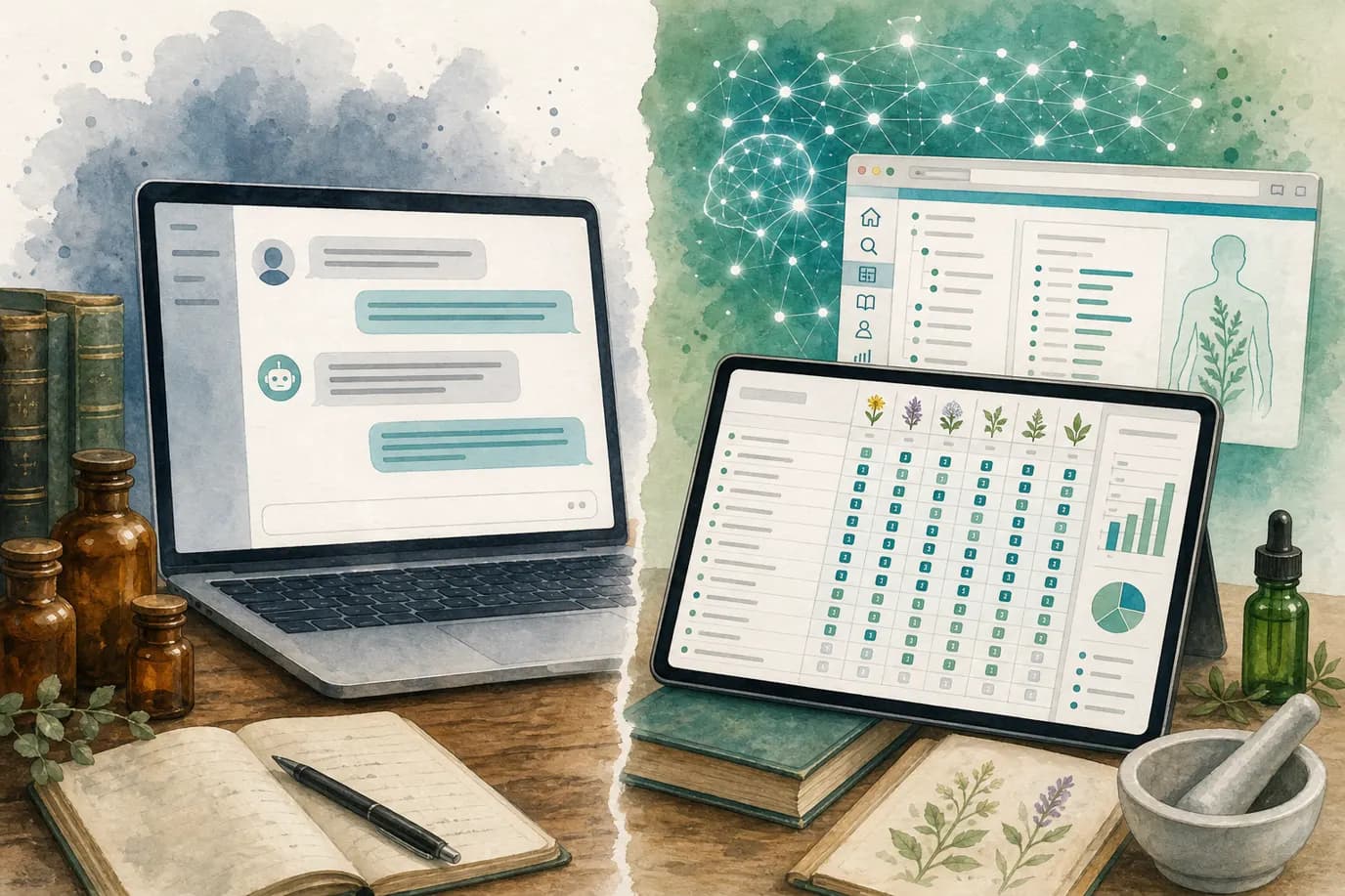
4. Full clinical platforms. The whole workflow — cases, repertory, materia medica, AI — as one app synced across devices. This is where practitioner value concentrates in 2026, because the phone's superpower isn't analysis, it's capture: live audio case taking turns the consultation into structured material while you keep your eyes on the patient.
What actually matters on a phone
Reviewing homeopathy apps for years teaches you that spec lists mislead; these five properties decide daily usefulness:
- Search that forgives. On a phone you type less and worse. Semantic search that maps casual phrasing to rubrics is worth more on mobile than anywhere else.
- Sync without ceremony. The case you opened on the desktop must simply be there on the phone. Anything involving export files loses by default.
- Dictation-first case taking. Typing a case on glass is misery; speaking it is natural. Transcription plus symptom extraction is the single biggest mobile win of the AI era.
- Thumb-sized clinical UI. Grades, rubric lists and remedy comparisons legible and tappable — designed for the screen, not shrunk onto it.
- An honest install story. The strongest "apps" in this space are installable web apps (PWAs): home-screen icon, full-screen launch, no store account needed, always current. Our step-by-step install guide covers Android, iPhone and desktop in five minutes.
The short list for 2026
Similia — the app this site exists for, so read with that in mind (full comparison with the desktop suites here). Installs as a PWA on Android, iPhone and desktop from one free account: seven classical repertories with semantic search, integrated materia medica, and synced case management. Pro adds the AI set — Notes-to-Rubric, case analysis, live audio transcription, photo analysis — plus unlimited cases and premium licensed repertories (Murphy, Complete). Built mobile-first for exactly the capture-on-phone, analyse-on-desktop rhythm described above.
Companion apps of the desktop suites. The established desktop platforms — Zomeo, Complete Dynamics and peers — ship mobile companions that extend an existing licence to the phone. If your practice already lives in one of those ecosystems, their companion app is the path of least resistance; expect reference and light case access rather than the full desktop feature set.
Public-domain readers. Free Kent repertory viewers and materia medica readers fill the reference niche admirably — no accounts, no cost, classical texts in your pocket. Their limits are the category's limits: no case continuity, no assistance, no sync. Our free resources roundup lists the ones worth having.
Choosing in ninety seconds
Match the app to the job you actually reach for your phone to do:
- "I need to check rubrics and read remedies on the go" → a repertory app with real search; free tiers suffice.
- "I take cases away from my desk" → a clinical platform with dictation and sync — this is where the AI era pays.
- "I prescribe for my family in acutes" → a scoped home-prescribing tool, not a professional instrument — and the remedy finder guide explains the boundary.
- "I already own a desktop suite" → its companion app first; a free platform account alongside costs nothing to compare.
The bottom line
The best homeopathy app of 2026 isn't a single download — it's whichever tool makes your between-desk work continuous with your desk work. For most practitioners and students that now means a platform that treats the phone as a first-class clinical device rather than a shrunken desktop. Install Similia as an app, take one real case on your phone — with live transcription if you're on Pro — and open the same case on your laptop afterwards. That round trip, more than any feature list, is the 2026 difference.