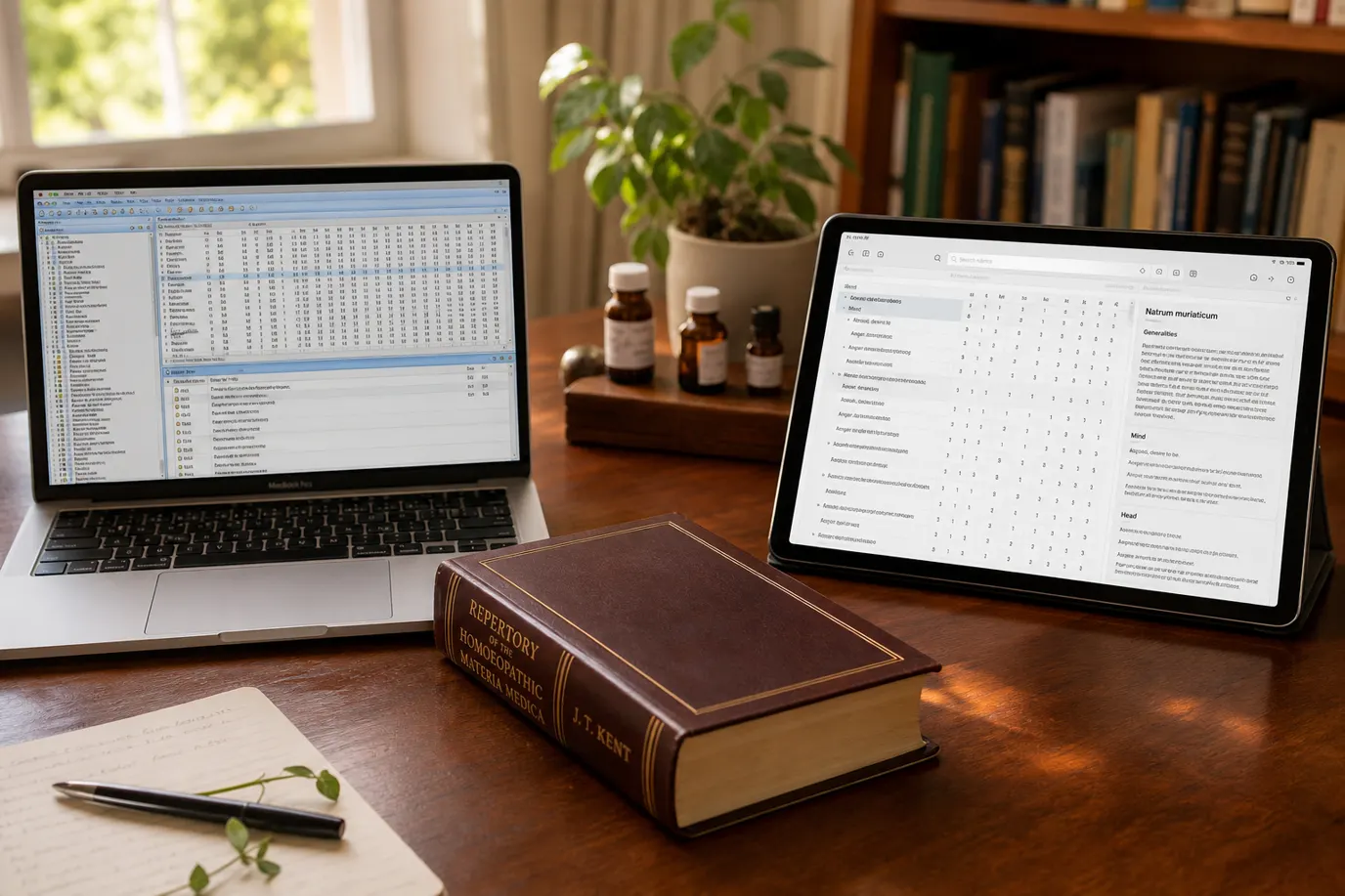

In short: OOREP is a free, open-source online repertory with Kent, Boger and Hering and no account required; Similia is a free-to-start browser platform that adds 21 materia medica books, semantic search, case management and, on Pro, an AI toolkit. Use OOREP for a quick rubric check and Similia for the whole case.
If you've searched for a free online repertory, you've almost certainly met OOREP — the "open online repertory" that thousands of homeopaths use for quick rubric lookups. It's one of the most sympathetic projects in the homeopathy software world: free, open-source, and refreshingly focused. Similia is also free to start, but it's a different kind of tool — a full clinical platform with AI assistance, materia medica, and case management built in.
So which one belongs in your practice? The honest answer, as usual, is "it depends on what you're doing" — and the two tools are different enough that the comparison is genuinely useful.
Disclosure: I'm the founder of Similia. I've tried to be even-handed below — OOREP is a project I respect, and corrections are welcome by email.
TL;DR — OOREP vs Similia at a glance
OOREP is a free, open-source web repertory. It gives you clean browser access to public-domain repertories — Kent's among them — with rubric search, remedy views, and optional saved case files. No installation, no payment, no fuss. Its scope is deliberately narrow: it is a repertory lookup tool, and a good one.
Similia is a free-to-start clinical platform. The free plan includes seven classical repertories, an integrated materia medica library, AI semantic search, and cross-device case management (with monthly limits). Pro plans add the AI toolkit — Notes-to-Rubric extraction, AI case analysis, live audio transcription, photo analysis — plus unlimited cases and licensed premium repertories.
If you want a fast, minimal, open reference — OOREP does that admirably. If you want the repertory embedded in an actual working environment — cases, materia medica, AI, eighteen interface languages — that's what Similia was built for.
What is OOREP?
OOREP (short for "open online repertory") is an open-source web application for repertorisation. Its source code is publicly available, and the hosted version is free to use. The concept is beautifully simple: type a symptom or browse chapters, get matching rubrics from public-domain repertories, see the remedies with their grades, and — if you create a free account — keep case files with your selected rubrics and their totals.
Because it leans on public-domain sources, you'll find the classical backbone of repertory work there: Kent's Repertory and other out-of-copyright works, in more than one language. Because it's a browser tool, it runs anywhere without installation. And because it's open-source, nothing about it is a black box — for teachers demonstrating how a repertory is organised, that transparency is a real virtue.
The trade-off is scope. OOREP is a reference tool, not a practice environment. There's no integrated materia medica study flow, no AI assistance for translating a patient's modern words into rubric language, no long-term patient record designed for years of follow-ups, and development moves at the pace a community project can sustain.
What is Similia?
Similia is a cloud platform for the whole clinical loop: case taking → repertorisation → materia medica verification → prescription → follow-up. The free forever plan includes seven classical repertories with semantic search, an integrated materia medica library, and case management that syncs across devices (free accounts have a monthly allowance of new cases; Pro removes the limits). Five AI features are part of the platform — semantic rubric search is free, while Notes-to-Rubric extraction, AI case analysis, live audio transcription of consultations and AI photo analysis belong to the Pro toolkit.
Where OOREP expects you to know (or learn) repertory language, Similia's semantic search meets you halfway: type "afraid of being alone at night" and it finds the rubrics whose 19th-century phrasing you might not guess. Where OOREP's case files hold rubric selections, Similia's cases hold the full record — narrative, symptoms, analysis, prescriptions, and follow-ups — with GDPR-compliant handling and export.
The platform is built by a small team funded by Pro subscriptions, which unlock licensed content that legally cannot be free — Murphy's MetaRepertory, the Complete Repertory, and other copyrighted modern sources — plus the AI toolkit and unlimited cases.
Side-by-side comparison
| OOREP | Similia | |
|---|---|---|
| Price | Free (open-source) | Free plan; Pro for premium content |
| Runs in browser | Yes | Yes — installable as an app (PWA) |
| Repertories | Public-domain classics (incl. Kent) | 7 classical free; Murphy + Complete Repertory on Pro |
| Repertory search | Text/rubric search | Semantic search in modern language (free) |
| Materia medica | Public-domain lookups | Integrated library, linked from analysis |
| Case management | Rubric-based case files (free account) | Full patient records, follow-ups, cross-device sync (free has monthly limits; Pro unlimited) |
| AI assistance | None (by design) | Notes-to-Rubric, AI analysis, live transcription, photo analysis (Pro) |
| Languages | A few (incl. English, German) | 18 interface languages |
| Source code | Open-source | Proprietary |
| Best fit | Quick rubric reference, teaching structure | Daily practice, students working full cases |
When OOREP is the better choice
- You want open-source, full stop. If software freedom is the priority, OOREP is the only serious browser repertory in that category, and it deserves the support.
- You need a two-minute rubric check. No login, no context — open a tab, find the rubric, read the grades, close the tab.
- You're teaching repertory structure. The undecorated presentation of chapters and rubrics is exactly what you want when the lesson is the repertory, not the software.
When Similia is the better choice
- You work cases, not just rubrics. The moment a lookup becomes a case — with a record, an analysis, a differential to verify in the materia medica, and a follow-up in six weeks — a reference tool stops being enough.
- Repertory language slows you down. Semantic search and Notes-to-Rubric exist precisely because patients say "she can't stand tight collars" and the repertory says something else.
- You practise in another language. With 18 interface languages and multilingual search, Similia serves practitioners the classical literature never translated for.
- You want one tool on every device. Installed on the phone for house calls, on the desktop for consultations, same cases everywhere.
For a wider map of no-cost tools — OOREP and Similia's free tier among them — our guide to free homeopathic resources online lists everything worth bookmarking.
Verdict
OOREP is the best pure open-source repertory on the web, and if a free rubric reference is all you need, you can stop reading and use it with a clear conscience. Similia plays a different game: it wraps the repertory in the rest of the clinical workflow — materia medica, cases, AI, languages — and its free plan means you don't have to choose with your wallet.
Try the free repertory with a real case — semantic search included — and see whether the difference between a reference and a working environment matters for the way you practise. If it doesn't, OOREP will serve you well, and that's a perfectly good outcome too.