

In short: Professional homeopathy software means licensed repertories with traceable sources, materia medica depth, patient records you could defend, AI that shows its working, the languages your patients speak, and pricing that is published. This checklist tests any product against those six points.
Every homeopathy tool calls itself professional. The word appears on hobby apps with scraped repertory text, on venerable desktop suites, and on everything between — which makes it useless as a label and useful as a question. What would software have to do, concretely, to deserve it?
After years of building for practitioners (and hearing, in detail, what previous tools got wrong), here is the checklist I'd apply to anything — ours included.
1. Licensed sources with visible provenance
The repertory is a two-century chain of scholarship, and modern editions — the Complete Repertory, Murphy's MetaRepertory — are living, licensed works. Professional software pays for what it ships and tells you exactly which edition you're reading. The alternative ecosystem of scraped, unattributed repertory text has two failure modes: legal exposure for the vendor, and silent corruption of grades and additions for you. A grade you can't trace is a grade you can't prescribe on.
The same standard applies to the materia medica: named authors, named editions, complete texts — not paraphrased remedy blurbs of unknown parentage.
2. Depth where cases are actually won
Acute prescribing can survive on keynotes; chronic work cannot. Professional software shows its depth in three places:
- Rubric coverage — including the small, peculiar rubrics where difficult cases turn, not just the popular chapters.
- Materia medica reach — enough sources to verify a differential from multiple angles: Kent's lectures for the grand picture, Boericke for clinical compression, Clarke and Allen for detail.
- Analysis flexibility — weighting symptoms, comparing remedy candidates side by side, and moving between repertory and materia medica without leaving the case.
A quick test: pick a strange, small symptom from a real case and see how far the software lets you chase it. Toys run out of road in two clicks.
3. Records that would survive an audit — and a decade
The clinical record is where "professional" stops being about features and starts being about duty. Two separate standards apply. The clinical one: totality, analysis, prescription and follow-ups preserved together, so that in 2031 you can see why 2026-you chose Natrum muriaticum. The legal one: health data is special-category data under GDPR — encryption, access control, export, deletion, and a vendor who signs a proper data processing agreement. Our guides to practice records and GDPR & HIPAA for homeopaths go deeper on both.
If a vendor is vague about where patient data lives, the conversation is over.
4. AI as an accelerant, not an oracle
AI has genuinely changed the mechanics of professional practice — live transcription that frees your eyes during case taking, semantic search that translates a patient's phrasing into candidate rubrics, drafted differentials that widen the field you consider. The professional standard for all of it is a single word: traceability. Every AI suggestion must resolve to rubrics you can inspect and sources you can read, with you approving or rejecting each step. Assistance that shows its work compounds your skill; assistance that replaces your work erodes it.
5. Reliability across a working day
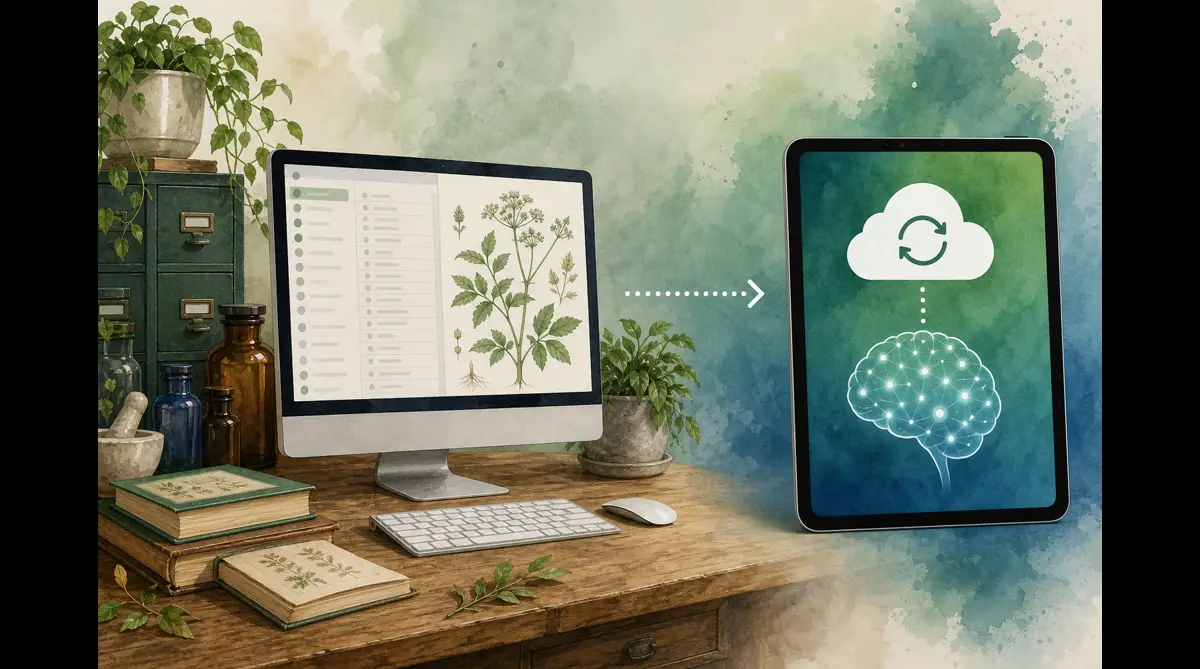
A modern practice is a phone at a house call, a desktop in clinic, a tablet in the evening. Professional software follows: same cases, same repertories, no licence gymnastics or per-device fees, and an interface that was designed for — not merely squeezed onto — each screen. Language matters here too: a practice serving patients in Spanish, German, Hindi or Turkish shouldn't have to work in English. Similia ships its full interface in 18 languages for exactly this reason.
6. A vendor built to still exist
The least glamorous criterion and, for a clinic, one of the weightiest: sustainable pricing you can see, active development you can observe, and an export path that respects the possibility of leaving. Free-forever tiers are professional when the funding model behind them is visible — in our case, public-domain content and core tooling stay free, and Pro subscriptions fund the licensed premium layer and the AI bills. What should worry you is any tool whose economics you can't explain.
Where Similia sits against its own checklist
Judged by the six standards: licensed premium repertories (Murphy, Complete) with provenance shown; an integrated multi-source materia medica; GDPR-grade case records with full history; AI that proposes and never disposes; one platform across every device in 18 languages; and open pricing with a genuinely free clinical tier. The full 2026 comparison puts us next to the established desktop suites, which retain real strengths — decades-deep licensed libraries above all — for practices anchored to a desktop workflow.
But the checklist is the point of this article, not the verdict. Bring one hard chronic case to any candidate — ours included — and score it honestly against the six standards. Professional software is the one that still looks professional at question six.