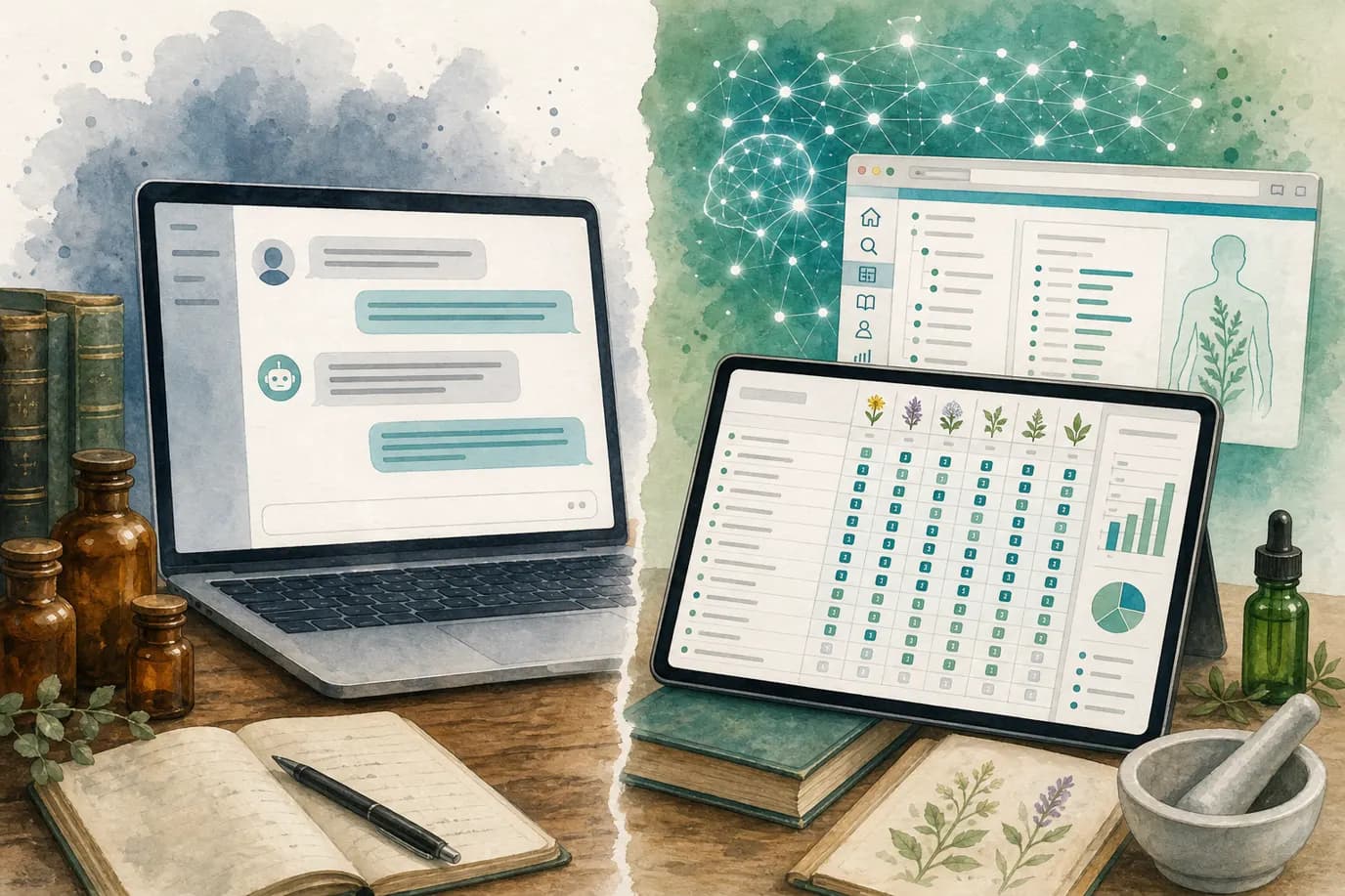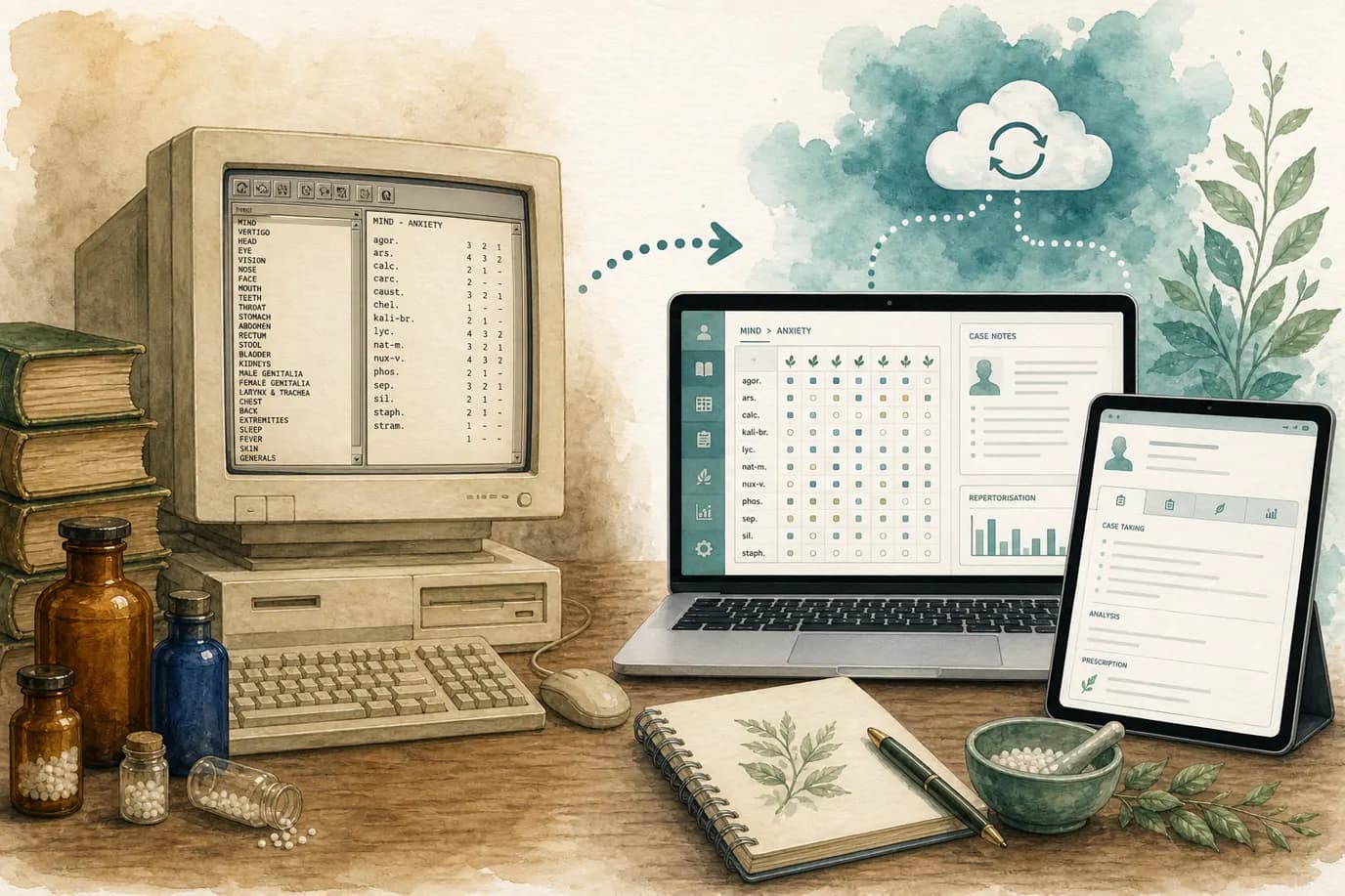

In short: Digital tools change three things in a homeopathic practice: rubric lookup becomes search, the materia medica sits next to the analysis, and cases live in one record instead of a filing cabinet. The classical method is unchanged; the time it takes is not.
For generations, homeopaths have relied on well-worn copies of Kent's Repertory, dog-eared materia medica volumes, and filing cabinets full of patient records. These physical tools have served the profession well, but they come with limitations that every practitioner knows intimately: the time spent flipping through pages to cross-reference symptoms, the weight of carrying multiple volumes between clinic and home, and the challenge of keeping patient records organized and secure.
Today, a quiet revolution is taking place in homeopathic practice. Practitioners around the world are discovering that digital tools can enhance—not replace—their classical training. Modern homeopathy software brings together trusted repertories, comprehensive materia medica, and intelligent search capabilities in ways that would have seemed impossible just a decade ago.
This guide explores how digital tools are reshaping homeopathic practice, what features matter most, and how practitioners at every level can benefit from making the transition.
The Evolution from Books to Bytes: Why Homeopathy Is Going Digital
The Traditional Challenges Practitioners Face
Every homeopath knows the scenario: a patient describes a complex set of symptoms, and you need to cross-reference between Kent, Boericke, and perhaps Boenninghausen to find the most fitting rubrics. With physical books, this means juggling multiple heavy volumes, marking pages with fingers or bookmarks, and manually comparing entries across sources.
The challenges extend beyond repertorization:
- Time consumption: Finding a single rubric can take several minutes when searching manually through printed indexes
- Physical limitations: Carrying a complete homeopathic library is impractical for home visits or travel
- Cross-referencing difficulty: Comparing the same remedy across multiple materia medica sources requires significant effort
- Case management: Paper-based patient files are vulnerable to damage, difficult to search, and challenging to organize as a practice grows
- Collaboration barriers: Sharing case information with colleagues or mentors requires physical copies or manual transcription
What Modern Practitioners Expect from Their Tools
The expectations of today's practitioners have evolved. Whether working from a busy clinic, a home office, or traveling for house calls, homeopaths increasingly need:
- Instant access to multiple repertories without physical storage constraints
- Powerful search capabilities that go beyond traditional indexing
- Cloud-based accessibility that syncs across devices
- Secure storage for sensitive patient information
- Tools that complement rather than complicate their clinical workflow
Key Benefits of Digital Homeopathy Software
Speed and Efficiency in Remedy Research
The most immediate benefit of digital homeopathy tools is speed. What might take several minutes with a physical repertory—locating a rubric, checking cross-references, comparing remedy grades—can be accomplished in seconds with well-designed software.
Consider searching for symptoms related to "burning pain in the stomach after eating." In a printed repertory, you would need to navigate to the stomach section, find the pain subsection, locate burning-type pains, then cross-reference with timing modalities. Digital repertory software allows you to search across all these parameters simultaneously, presenting relevant rubrics in moments.
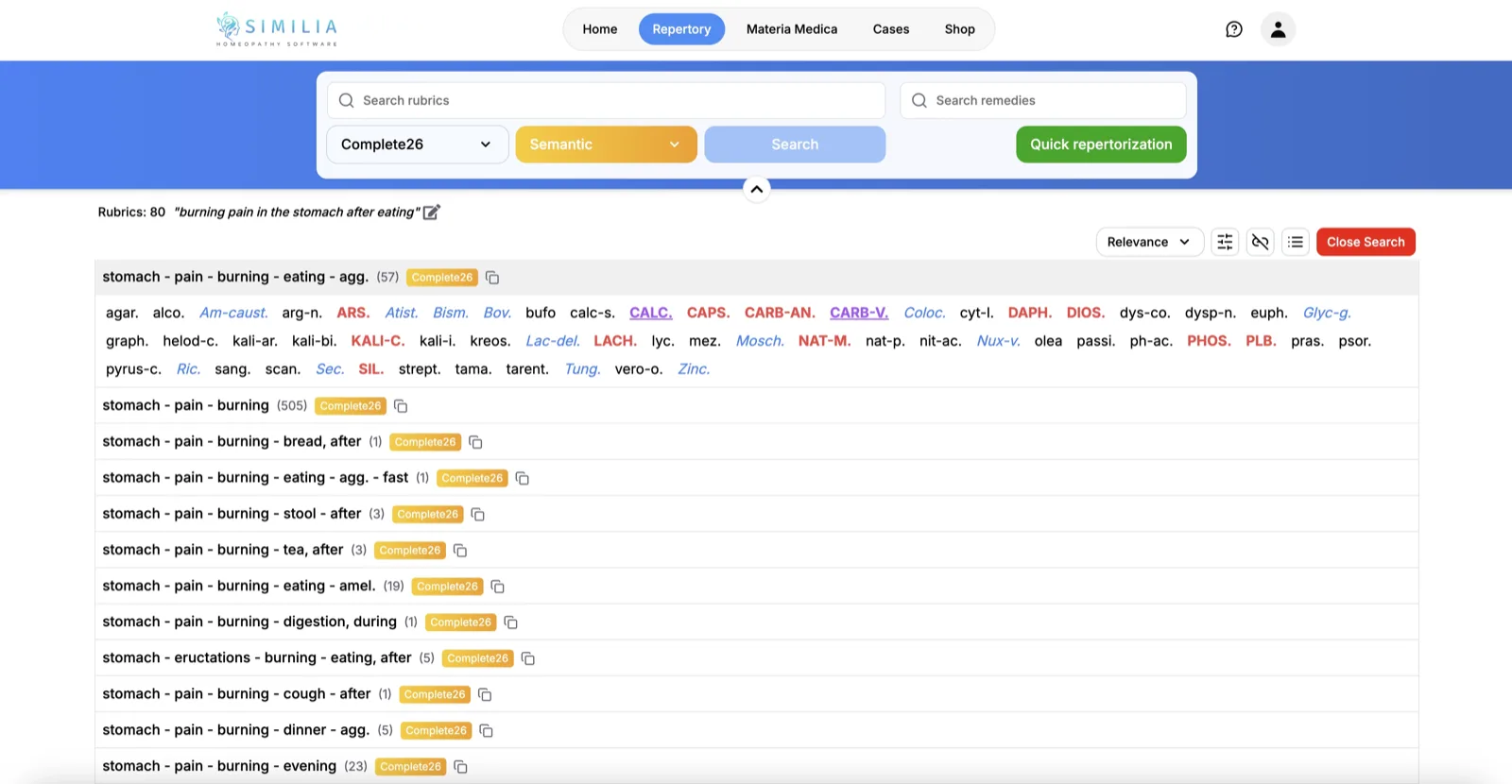
This efficiency compounds throughout a consultation. When each rubric lookup saves a minute or two, the cumulative time savings across a full case analysis becomes substantial—time that can be redirected toward the patient relationship and clinical observation.
Access to Comprehensive Resources in One Place
Digital platforms eliminate the need to maintain extensive physical libraries. A single application can provide access to:
- Classic repertories: Kent, Boericke, Boenninghausen, Hering, Boger
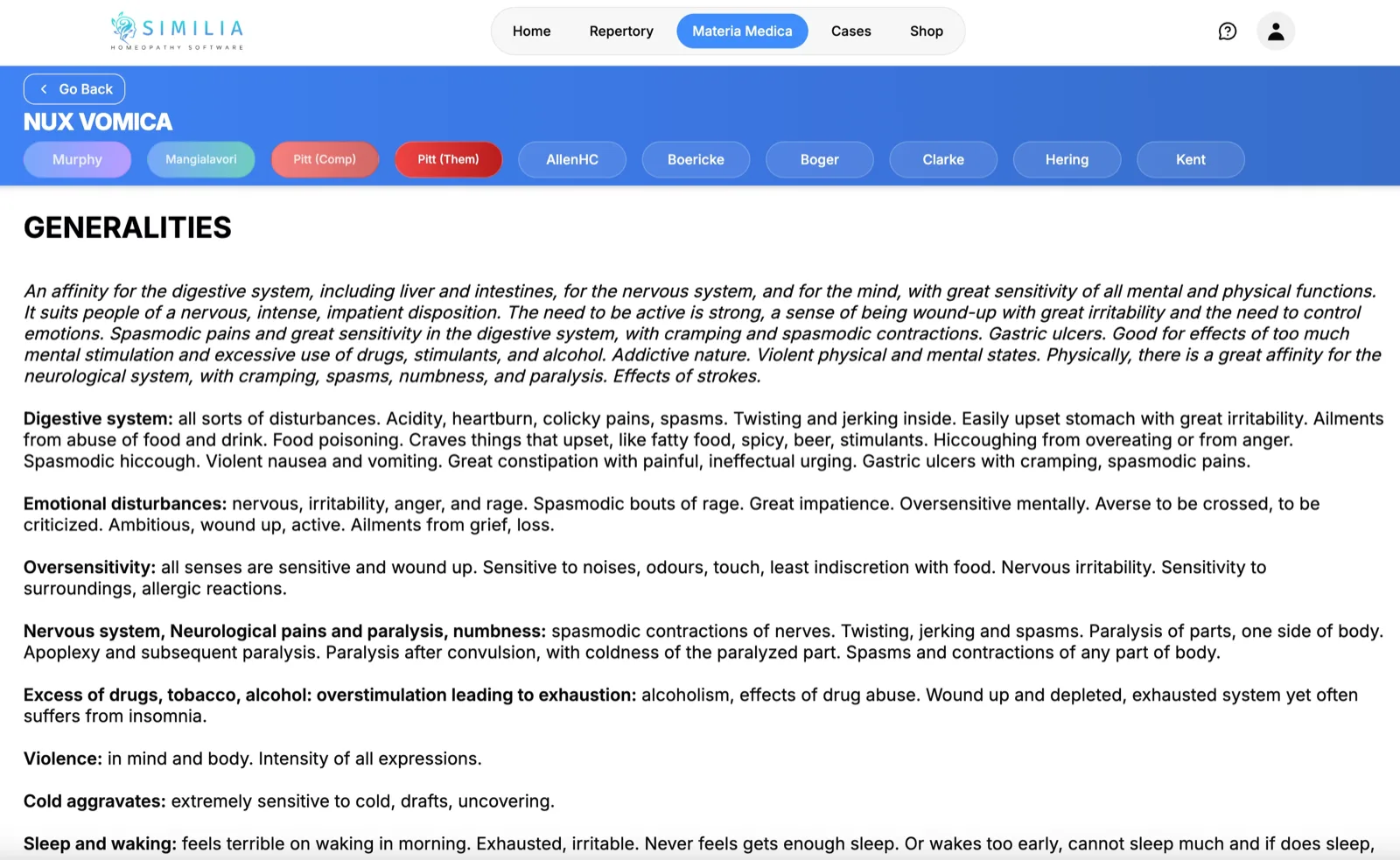
- Materia medica: Clarke, Allen, Boericke, Kent, and more
- Specialized resources: Thematic repertories, proving collections, and contemporary additions
This consolidation is particularly valuable for students building their knowledge base and for practitioners who want to compare approaches across different homeopathic traditions without investing in dozens of expensive volumes.
Enhanced Case Management and Organization
Beyond repertorization, digital tools transform how practitioners manage their practice:
- Patient records: Store consultation notes, prescriptions, and follow-up observations in organized, searchable formats
- Treatment history: Track remedy responses over time, making pattern recognition easier
- File attachments: Link lab results, photographs, and documents directly to patient cases
- Cloud backup: Protect years of clinical records from physical damage or loss
- Multi-device access: Review cases from your clinic computer, home laptop, or phone
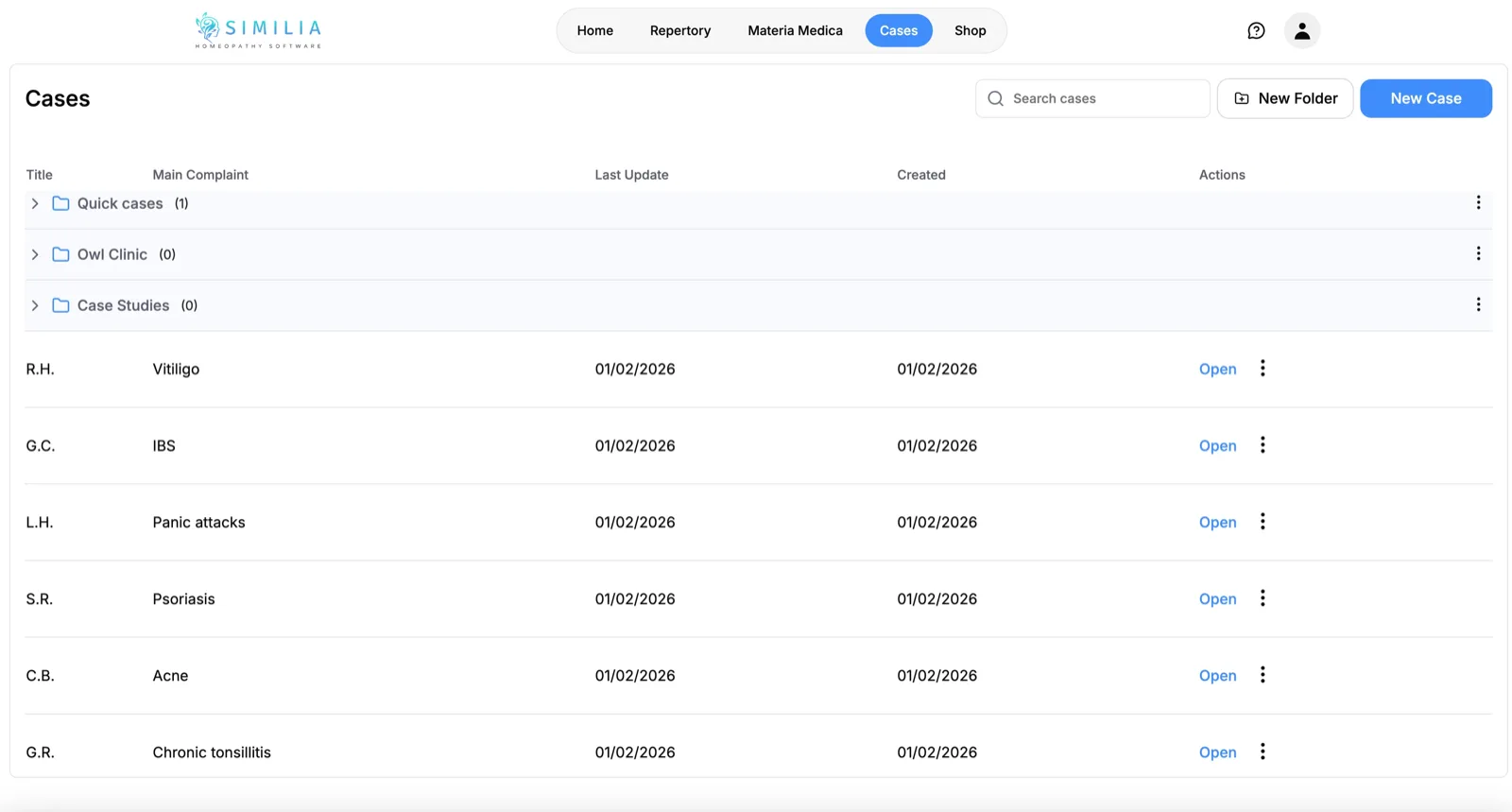
For a deeper look at the modern approach to patient assessment and documentation, see our guide to homeopathic case taking.
AI-Powered Features That Support Clinical Judgment
Perhaps the most significant advancement in recent homeopathy software is the integration of artificial intelligence—not to replace the practitioner's judgment, but to support it.
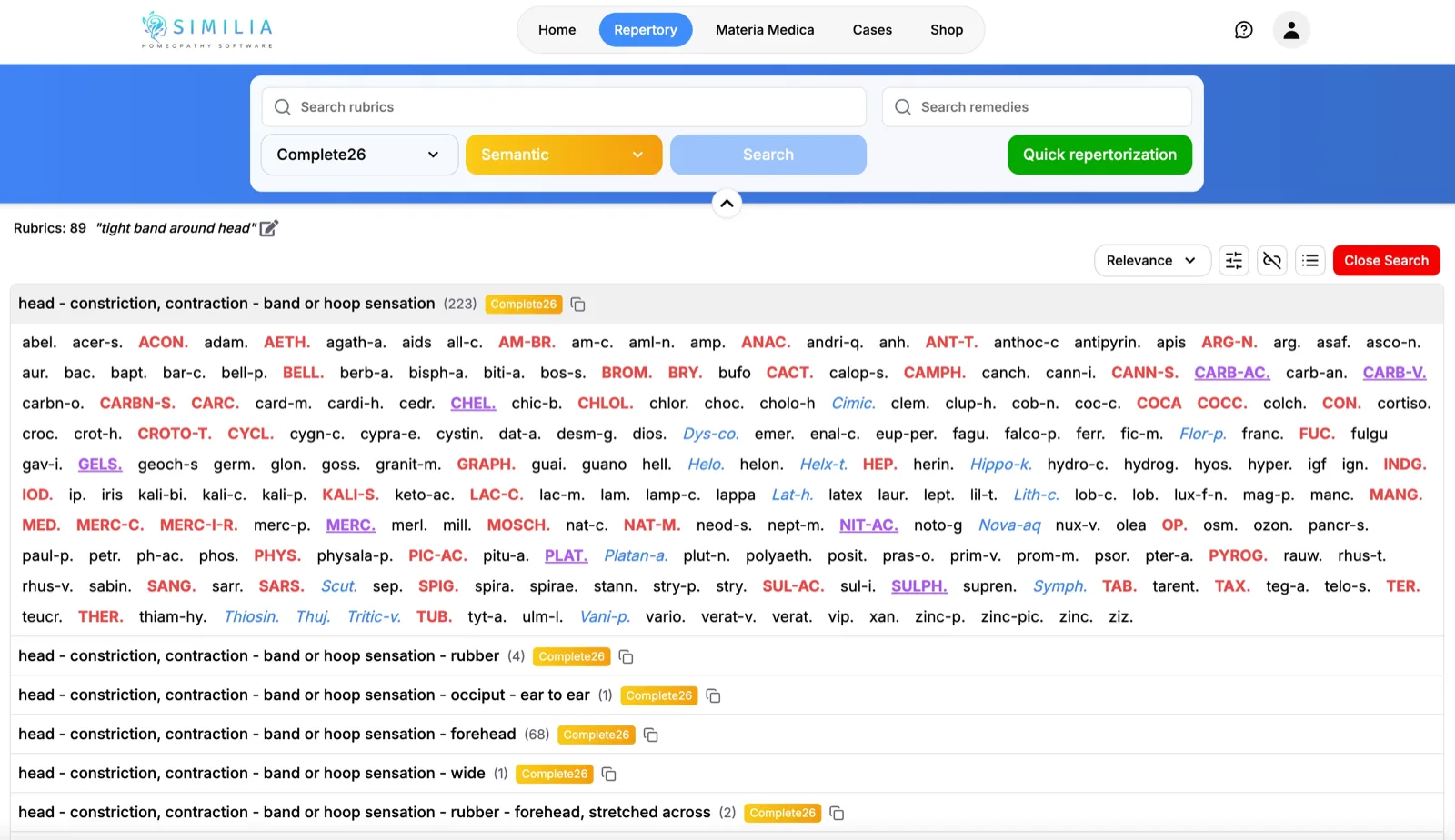
Semantic search represents a breakthrough for many practitioners. Traditional repertories use 19th-century medical terminology that can differ significantly from how patients describe their symptoms today. AI-powered semantic search bridges this gap by understanding the meaning behind a patient's words and matching them to relevant rubrics.
For example, when a patient says their headache feels like "a tight band around my head," semantic search can identify this as relevant to constricting or pressing headache rubrics, even without the practitioner needing to translate the description into classical terminology first.
Notes-to-rubrics conversion takes this further by analyzing free-form consultation notes and suggesting relevant rubrics based on the symptom descriptions they contain. This can serve as a useful cross-check for practitioners and a learning tool for students developing their repertorization skills.
Tools like Similia use AI to bridge the gap between how patients describe symptoms and how rubrics are traditionally worded—helping practitioners find relevant rubrics without memorizing antiquated terminology.
Comparing Digital and Traditional Approaches
| Aspect | Traditional (Books) | Digital Software |
|---|---|---|
| Search Speed | Minutes per rubric | Seconds |
| Portability | Heavy, multiple volumes | Any device |
| Cross-referencing | Manual, time-consuming | Instant |
| Case Storage | Physical files | Secure cloud |
| Backup | Vulnerable to damage | Automatic |
| Collaboration | Difficult | Real-time sync |
| Cost | Hundreds per book | Free to affordable |
| Updates | Buy new editions | Automatic |
This is not to suggest that physical books have no place in modern practice. Many practitioners find value in having certain key texts on their shelves, and some prefer the tactile experience of page-based reading for deep study. The most effective approach often combines the accessibility of digital tools for clinical work with physical books for contemplative reading and study.
What to Look for in Homeopathy Software
Essential Features for Practitioners
When evaluating homeopathy software, consider whether it includes:
- Trusted repertory sources: Look for classic repertories (Kent, Boericke, Boenninghausen, Hering, Boger) from recognized publishers or homeopathic authorities
- Comprehensive materia medica: Multiple authoritative sources allow for richer remedy understanding
- Flexible repertorization: Support for different analysis methods (numerical, weighted, etc.)
- Case management: The ability to save, organize, and search patient records
- Search capabilities: Both traditional keyword search and, ideally, semantic or AI-powered search
Security and Privacy Considerations
Patient data security is non-negotiable. For a comprehensive overview of privacy regulations that apply to homeopathic practitioners, see our HIPAA and GDPR compliance guide. When evaluating any platform that will store consultation records, verify:
- Encryption: Data should be encrypted both in transit and at rest
- Compliance: The platform should meet relevant medical data protection standards
- Data ownership: You should retain full ownership of your patient data
- Privacy policy: The provider should not sell or share your data with third parties
- Access controls: Only you should be able to access your patient records
Accessibility and Pricing
The homeopathy software market includes options at various price points:
- Free tiers: Some platforms offer substantial functionality at no cost, making them accessible to students and practitioners on tight budgets
- Premium subscriptions: Additional repertories, specialized resources, or advanced features may require payment
- One-time purchases: Some traditional software uses perpetual licensing rather than subscriptions
- Clinic plans: Multi-practitioner options for group practices
When evaluating options, look for platforms that offer a robust free tier with essential resources. For example, Similia provides access to classic repertories, materia medica, AI-powered semantic search, and case management at no cost—with premium options for those needing additional repertories like Murphy's MetaRepertory or Complete Repertory. For a detailed breakdown of what's included in each tier, see our complete guide to Similia Free vs Pro plans.
How AI Is Changing Homeopathic Research
Understanding Semantic Search in Homeopathy
Traditional repertory search requires practitioners to know exactly how symptoms are categorized and worded in each source. This presents a learning curve, particularly for students, and can mean missed rubrics when a symptom description doesn't match the expected terminology.
Semantic search works differently. Instead of matching exact words, it understands the meaning of a symptom description and finds rubrics with similar meanings. This approach:
- Allows searching in natural, conversational language
- Finds relevant rubrics even when terminology differs
- Helps practitioners discover rubrics they might not have thought to search for
- Reduces the gap between patient language and repertory language
Example in practice: A patient describes feeling "like I need to take a deep breath but can't quite fill my lungs." Traditional search would require knowing the exact rubric wording. Semantic search can understand this description and surface rubrics related to respiration, dyspnea, and the sensation of incomplete breathing.
From Notes to Rubrics: AI-Assisted Case Analysis
Another application of AI in homeopathy software is analyzing consultation notes to suggest relevant rubrics. This feature allows practitioners to:
- Paste or type their raw consultation notes
- Receive suggestions for rubrics that match the described symptoms
- Use these suggestions as a starting point or cross-check for their own analysis
This capability is particularly valuable for complex cases with many symptoms, where it's easy to overlook connections, and for students learning to translate patient descriptions into repertory language.
Visual Symptom Analysis
Some advanced platforms now offer the ability to analyze photographs of physical symptoms—rashes, swelling, skin conditions—and suggest relevant rubrics based on visual characteristics.
This technology supports:
- Consistent documentation of physical findings across visits
- Identification of visual symptoms that might match specific rubrics
- A visual record that complements written notes
Real-World Impact: How Practitioners Use Digital Tools
Practitioners across different settings are finding that digital tools enhance their workflow:
Dr. Helena Vance, a classical homeopath with 15 years of experience, shares her perspective:
"Switching to Similia transformed how I work with complex chronic cases. The ability to cross-reference multiple repertories instantly means I catch rubrics I would have missed before. My case analysis is more thorough, and I spend less time flipping through books and more time really listening to my patients."
Michael Torres, who runs a busy family practice, emphasizes the workflow improvements:
"What sold me was how seamlessly everything works together. I take notes during consultations, the AI suggests rubrics I might have overlooked, and everything syncs to my laptop for deeper analysis later. The security features give me peace of mind with patient data, and the free tier has everything I need for daily practice."
Anna Lindqvist, a recent graduate building her first practice, highlights accessibility:
"As a new practitioner, I couldn't afford expensive software licenses on top of my book collection. Similia gave me professional-grade tools from day one. The semantic search has been invaluable for learning—when patients describe symptoms in their own words, I can find the right rubrics without memorizing every archaic term in Kent."
Getting Started with Digital Homeopathy Tools
Making the Transition from Books
For practitioners accustomed to physical books, the transition to digital tools works best as a gradual process:
- Start alongside, not instead of: Use digital tools in parallel with your books initially, building familiarity without pressure
- Begin with one function: Focus on repertorization first, then explore case management features once comfortable
- Take advantage of free tiers: Most quality platforms offer free access to core features, allowing you to explore without financial commitment
- Give yourself time: Like any new tool, there's a learning curve. Allow a few weeks of regular use before evaluating
Choosing the Right Platform for Your Needs
Different practitioners have different requirements:
- Students: Prioritize access to classical resources, learning-friendly interfaces, and affordable or free pricing
- Independent practitioners: Look for robust case management, reliable cloud sync, and a balance of free and premium features
- Clinics and group practices: Consider multi-seat options, collaboration features, and priority support
Not sure which tier is right for you? Our Similia Free vs Pro comparison guide breaks down every plan, edition, and add-on to help you decide.
The Future of Homeopathic Practice Is Digital
Digital tools represent a natural evolution in how homeopaths access and apply their knowledge. The core principles of homeopathy remain unchanged—careful case-taking, individualized prescribing, and the art of remedy selection. What changes is the efficiency and accessibility of the resources that support this work.
Technology enhances rather than replaces the practitioner's judgment. AI can suggest rubrics, but the homeopath decides which are most relevant. Software can organize cases, but clinical insight comes from training and experience. The goal is to reduce friction in the research and administrative aspects of practice, freeing more time for what matters most: understanding and helping patients.
For practitioners who haven't yet explored digital homeopathy tools, there has never been a better time to start. The availability of comprehensive free options means you can experience the benefits without financial risk, and the learning curve is gentler than you might expect.